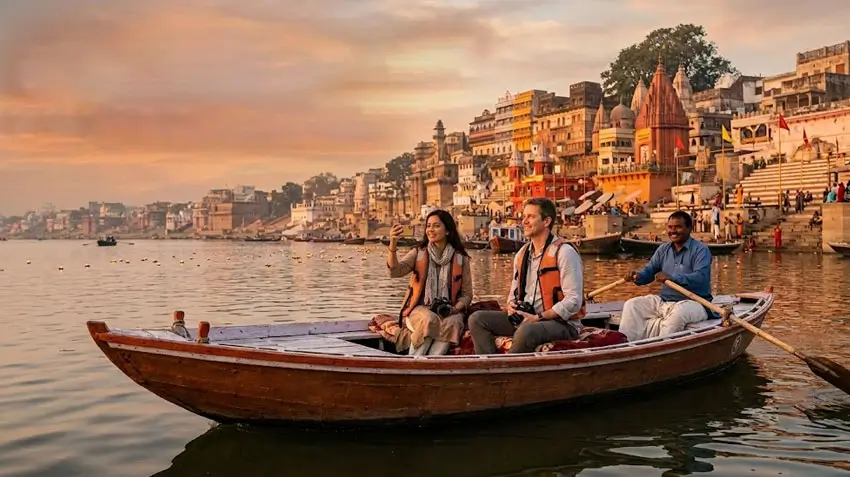
A private sunrise boat ride in Varanasi is one of the most memorable ways to see the city because the riverfront feels completely different at dawn from the crowded lanes and busy ghats of the daytime. Before the city reaches its full intensity, the Ganges is often comparatively calm, the air is cooler, devotional activity begins along the steps, temple bells can be heard from the riverbank and the first light gradually reveals the long line of historic ghats. For foreign travellers, this early-morning perspective often provides a clearer understanding of Varanasi than seeing the river only during the evening Ganga Aarti.
The experience, however, depends heavily on how the boat ride is arranged. Visitors arriving at a busy ghat without a confirmed boat may be approached by several boatmen quoting different prices, offering different durations and sometimes promising routes that are not clearly explained. A traveller who has never visited Varanasi may not know whether the boat is appropriately sized, whether life jackets are available, how difficult the boarding point will be or whether the quoted price covers the complete private ride.
For this reason, travellers who value comfort and reliability should consider pre-booking a private boat ride in Varanasi through an established travel company, hotel, local experience provider or a trusted boat operator. A confirmed arrangement allows the pickup time, meeting point, boat category, duration and cost to be agreed before the traveller reaches the river.
The official Varanasi district tourism information specifically describes the approximately six-kilometre sweep of the ghats as especially striking at dawn and notes that boats are available for hire around Dashashwamedh Ghat. That recommendation reflects what experienced visitors quickly understand: Varanasi is at its most atmospheric when viewed from the water as the day begins.
For a premium private experience, the objective should not be simply to secure the cheapest wooden boat. The traveller should know where they are boarding, how long they will be on the river, which section of the ghats will be covered, whether the boat is private to their party and what happens if weather or river conditions affect the ride.
The principal advantage of sunrise is the combination of light, temperature and activity along the ghats. Varanasi's riverfront stretches for kilometres, and the changing dawn light allows travellers to see its architecture gradually emerge rather than viewing everything under the stronger sunlight of late morning.
The official district tourism information describes the ghats as particularly impressive in the first light of dawn, when the riverfront takes on a timeless appearance and the activities of devotees unfold along the water. For photographers, this softer light is far more useful than the harsh overhead light that can dominate later in the day.
Early morning is also when many local religious practices become visible. Pilgrims enter the river for ritual bathing, priests conduct prayers, residents perform yoga or meditation and smaller devotional ceremonies take place along different ghats. Assi Ghat is especially associated with early-morning cultural and spiritual activity, including prayer, yoga and music-related programmes.
A boat provides enough distance to observe these activities respectfully without standing directly beside worshippers. This can be particularly valuable for foreign visitors who want to understand what is happening without feeling that they are intruding.
The temperature is another reason to go early. During warmer months, Varanasi can become extremely hot by late morning. A sunrise departure allows travellers to spend an hour or more on the river before the day's heat becomes uncomfortable.
Traffic is also generally lighter when the hotel pickup takes place before sunrise. Varanasi's roads can become congested later in the morning, particularly around old-city approaches, major temples and popular ghats. An early departure therefore reduces some of the logistical stress involved in reaching the river.
Witness the magical sunrise over the Ganges with a private boat ride in Varanasi, creating unforgettable memories of India’s spiritual heritage.
There is no single departure time that works throughout the year because sunrise changes with the season. A sensible Varanasi sunrise boat ride timing is generally around 20 to 40 minutes before the actual sunrise so that travellers are already on the water when the sky begins to change.
During periods when sunrise occurs relatively early, guests may need to leave the hotel before 5:00 AM. At other times of year, the meeting time may be closer to 5:30 or 6:00 AM.
The correct departure should therefore be confirmed according to the travel date rather than copied from a generic online schedule.
A high-quality operator will usually ask guests to arrive at the boarding point before sunrise rather than at sunrise. If the sun is already above the horizon when the boat begins moving, one of the most attractive parts of the experience has been missed.
Hotel location also affects the pickup time. A guest staying in the old city may be within walking distance of the river, while a traveller staying in a larger hotel farther from the ghats may require a vehicle transfer followed by a short walk.
For a premium arrangement, the operator should tell the traveller exactly when to leave the hotel, how long the road transfer will take and whether walking is required to reach the boat.
Foreign visitors should avoid scheduling the ride too tightly before a flight or train departure. Even though the boat journey itself may be only an hour or two, traffic, walking and breakfast after the ride all need time.
A short private boat ride on the Ganges in Varanasi can last approximately 45 to 60 minutes, while a more complete sunrise experience commonly works better at around 75 to 90 minutes. Travellers who want to see a broader section of the riverfront and spend time observing the ghats without feeling rushed may prefer around 90 minutes.
A very short ride can become little more than a quick loop around the boarding ghat. That may be enough for someone with limited time, but it does not provide the same sense of the riverfront.
A longer private ride allows the boat to move gradually past several important ghats while the city awakens. Depending on the starting point and river conditions, the route may include views toward Assi Ghat, Dashashwamedh Ghat, Man Mandir Ghat, sections around the old city and the cremation ghats.
The route should be discussed before departure.
Travellers should be particularly cautious when an operator promises a huge number of ghats within an unrealistically short period. Varanasi has a long riverfront, and seeing every ghat in detail during a one-hour ride is impossible.
The purpose is not to race from one landmark to another. The value comes from moving slowly enough to absorb the riverfront.
Dashashwamedh Ghat is one of the most widely used areas for boat access because it is centrally located along the famous riverfront. The district tourism authority notes that boats can be hired from this area. However, it is not the only possible boarding point.
Assi Ghat is another practical starting area, especially for travellers who want to combine the boat ride with the early-morning activities for which Assi is known. Depending on hotel location and route preference, starting from Assi can create a relaxed progression toward the central ghats.
Other boarding points may also be arranged by private operators.
The most important factor is accessibility.
The ghats consist of substantial flights of stone steps, and water levels change. This means the exact point where a boat is tied can vary. During some periods, reaching the boat may involve descending many steps. During other periods, temporary boarding arrangements may be used closer to the upper ghat level.
Senior travellers and anyone with restricted mobility should disclose this when booking. The operator can then choose a more manageable boarding point if available or arrange additional assistance.
Travellers should not assume that a chauffeur can drive directly beside the boat. Many old-city areas around the river are pedestrianized, restricted or too narrow for normal vehicle access. The final part of the journey may therefore require walking.
Prices for a private sunrise boat ride in Varanasi vary according to boat type, duration, number of passengers, route, season and whether a guide accompanies the travellers.
For a basic private wooden rowboat, foreign visitors can reasonably budget around ₹1,500 to ₹3,000 or more for a shorter private ride, depending on duration and negotiation.
A more organized private arrangement with a pre-confirmed boat, experienced boatman, better seating and assistance can cost approximately ₹2,500 to ₹5,000 or more.
Motorized or larger boats can be priced higher, especially when booked privately for families or groups. Premium setups with cushions, hotel transfers, guide assistance or special sunrise arrangements can move into the ₹5,000 to ₹10,000+ range depending on what is included.
These should be treated as practical premium budgeting estimates rather than official fixed tariffs. Boat pricing in Varanasi can vary, and travellers booking directly at the ghats may encounter both lower and higher quotations.
The correct question is not simply, "How much is the boat?"
Ask what the price includes. Is the ride private? How long does it last? Which ghats are covered? Is a motorboat or rowboat being used? Does the price include hotel pickup? Is a guide included? Are taxes or any additional fees payable?
A ₹1,500 boat that lasts forty minutes is not necessarily better value than a ₹3,000 boat providing a private 90-minute ride with a reliable meeting arrangement.
A traditional wooden rowboat in Varanasi can provide the quieter and more atmospheric sunrise experience. Without the noise of an engine, travellers hear the sounds coming from the ghats more clearly, and the boat moves slowly enough to appreciate the architecture and morning rituals.
For couples and small private groups, a rowboat can be an excellent choice when river conditions are suitable.
The disadvantage is speed. A manually rowed boat covers less distance, so travellers who want to see a wider section of the ghats within a limited period may prefer a motorized option.
A private motorboat in Varanasi can cover more of the riverfront and may be useful for larger parties, senior travellers or guests with limited time. The journey can also be less physically demanding for the boatman over longer distances.
The trade-off is noise and a less traditional atmosphere.
Some travellers choose a motorboat for a longer route while asking the operator to reduce speed around key sections.
The best choice depends on whether the priority is atmosphere or coverage.
For sunrise photography and a slow spiritual experience, a rowboat is often preferable. For families wanting to see a longer stretch of the ghats before returning to the hotel, a motorboat may be more practical.
Enjoy a peaceful private boat journey along the sacred Ganges and admire Varanasi’s ancient ghats in the gentle morning light.
Safety should be taken seriously whenever a boat is used, regardless of how calm the river appears.
The first question should be whether life jackets are available. Even confident swimmers should use appropriate safety equipment where supplied, particularly on motorized boats or when travelling with children.
The boat should not be overloaded. A vessel that appears crowded should not be accepted simply because the boatman says another few people can fit.
Private travellers should confirm that the boat is exclusively reserved for their party if that is what they paid for. This prevents unexpected passengers from being added at the last minute.
Boarding requires particular care because stone steps and boat surfaces can be slippery. The boatman should stabilize the vessel while passengers enter, and travellers should use available hand support rather than jumping down from the ghat.
Footwear with reasonable grip is preferable to slippery sandals.
Children should remain seated while the boat is moving and should not lean over the side.
Foreign travellers should also avoid standing for photographs unless the boatman says it is safe to do so. Small wooden boats can shift considerably when several passengers change position at once.
River conditions need to be respected. During periods of high water, strong current or adverse weather, boat operations may be restricted or suspended. A trustworthy operator should cancel or modify the ride rather than forcing a departure simply because the booking has been paid for.
The Ganges changes dramatically through the year. During periods of heavy rain and increased river levels, currents can strengthen, ghats can become partially submerged and local authorities may restrict boating for safety reasons.
Travellers visiting during the monsoon should therefore understand that a sunrise boat ride cannot always be guaranteed.
A professional operator should check current conditions and follow local restrictions.
If boating is suspended, travellers can still visit the ghats from land where access is safe, but the experience will naturally be different.
High water can also alter boarding points. Steps normally used during lower river levels may disappear under water, and boats may approach the upper sections of the ghats differently.
This is another reason to avoid relying solely on information from an old travel blog.
The exact operating situation should be checked close to the date of travel.
Premium travellers should ask about the cancellation or refund policy when paying in advance, particularly during weather-sensitive periods.
The strength of a sunrise boat ride lies in seeing the ghats as a continuous riverfront rather than as isolated attractions.
Assi Ghat is one of the important southern areas and is especially lively in the early morning. The official district information mentions morning spiritual and cultural activities at Assi, including prayer and yoga. Seeing these activities from the river can provide an excellent beginning to the ride.
Dashashwamedh Ghat is among the most famous central ghats and later becomes the focal point for the well-known evening Ganga Aarti. In the early morning, it is active without the intense evening crowds.
Man Mandir Ghat and the surrounding historic riverfront provide some of the most striking architectural views from the water.
The cremation ghats, particularly Manikarnika Ghat, form an important part of Varanasi's religious landscape. Foreign travellers should approach these areas with sensitivity. Cremations are not tourist performances, and photography should be avoided where it would intrude on families or religious rites.
A knowledgeable guide can explain the cultural and religious significance without turning a private ceremony into a spectacle.
The boat ride is strongest when it balances observation with respect.
A guide is not essential for every traveller, but a good private guide in Varanasi can add considerable value to the boat experience.
Without context, visitors may see dozens of temples, palaces, ghats and ritual activities without understanding how they relate to one another.
A knowledgeable guide can explain why different ghats are important, how religious practices vary, the history of the riverfront architecture and appropriate etiquette around cremation and worship.
The guide can also help manage practical details such as locating the correct boat and communicating with the boatman.
For foreign travellers visiting Varanasi for the first time, combining a private sunrise boat ride with an English-speakin guide is often worth the additional cost.
However, the guide should allow periods of silence.
The sunrise ride is not improved by nonstop commentary. Some of the most memorable moments occur when passengers simply watch the city from the river.
A skilled guide understands when explanation is useful and when the experience should speak for itself.
Varanasi is exceptionally photogenic at sunrise, but photography requires both practical preparation and cultural sensitivity.
The changing light can be beautiful, but the boat is constantly moving. Travellers using larger cameras should keep straps secured and avoid changing lenses carelessly over the water.
A small cloth is useful because moisture and river spray can reach equipment.
Smartphone photography is much easier and can produce excellent results during the early light.
Travellers using expensive cameras should consider a protective bag, particularly when boarding.
The most important rule is respect.
Wide photographs of the riverfront, architecture and general morning activity are normally much less intrusive than close photographs of individuals performing religious rituals.
Cremation sites require particular sensitivity.
Do not treat bereaved families as photographic subjects. If a guide or boatman says photography is inappropriate, follow that advice.
Drones should not be used casually. Airspace, security and local restrictions apply, and flying a drone over crowded ghats or religious sites creates obvious safety and privacy concerns.
Start your day in Varanasi with a private sunrise boat ride, beautiful river views and an authentic cultural experience along the Ganges.
Clothing should be chosen according to both temperature and local context.
Winter mornings in Varanasi can be surprisingly cold, especially on an open boat where the river breeze increases the feeling of chill. Foreign travellers visiting during cooler months should bring a warm layer, scarf or light jacket.
Fog can also be present during winter mornings, occasionally reducing visibility and delaying the appearance of the sun.
During warmer periods, lightweight clothing is more comfortable, but shoulders and knees should be covered reasonably when combining the boat trip with temple areas and religious sites.
Comfortable shoes with grip are important because the ghat steps may be uneven or damp.
Travellers should avoid carrying unnecessary bags. A small secure day bag containing a phone, camera, water and perhaps a light layer is usually enough.
Large handbags and loose valuables complicate boarding.
A Varanasi boat ride for senior travellers can be extremely rewarding, but access should be considered before booking.
The boat journey itself may be comfortable once the passenger is seated. The more difficult part can be reaching the vessel because the ghats contain many stone steps.
Senior guests with knee problems should tell the operator before the booking is confirmed.
A suitable starting ghat should be selected, and assistance should be arranged for boarding.
A larger, more stable boat may be preferable to a very small wooden vessel.
Travellers should also avoid an unnecessarily long ride if sitting without easy access to a restroom may become uncomfortable.
A 60- to 75-minute private ride can sometimes be better than a two-hour journey for elderly guests.
If mobility is severely limited, the operator should honestly assess whether the available access is safe rather than promising an unrealistic arrangement.
Families can take children on a private Varanasi boat ride, but safety and duration need careful attention.
A private boat is preferable because parents can control the environment rather than sharing the vessel with unknown passengers.
Life jackets should be requested for children, and parents should check that the size is appropriate.
Children should stay seated while the boat is moving.
A 60-minute ride may be sufficient for younger children who are unlikely to remain interested for much longer.
Parents should bring water and a light snack if necessary, but food should be handled carefully and rubbish should never be thrown into the river.
Very young children may find the pre-dawn wake-up difficult. Families should consider the child's normal routine rather than forcing the experience simply because it appears on a sightseeing list.
A sunrise boat ride can be combined with a short walk through the old city or a visit to nearby religious areas, but the morning should not become overpacked.
After disembarking, travellers may walk through selected lanes with a guide while markets and temples begin opening.
Guests interested in the Kashi Vishwanath Temple should arrange the visit separately according to current entry and security procedures, particularly because temple access can involve substantial queues and restrictions on personal belongings.
Another option is to return to the hotel for breakfast before beginning the rest of the day's sightseeing.
This can be particularly sensible for travellers who started before 5:00 AM.
Varanasi is intense, and an early morning followed immediately by an uninterrupted full sightseeing day can become tiring.
A premium itinerary should preserve enough time for rest.
Luxury hotels and established travel operators generally charge more than a direct arrangement with a boatman, but they also provide greater accountability.
A hotel booking may include vehicle transfer, an escort to the ghat, a confirmed private boat and easier problem resolution if something changes.
Direct booking at the ghat can be cheaper and may work perfectly well for experienced travellers who are comfortable negotiating locally.
The disadvantage is uncertainty over price, duration and exact boat quality.
For first-time foreign visitors, the difference of a few thousand rupees is often worth paying for a properly organized private Ganges boat ride in Varanasi.
Travellers should avoid paying large amounts in advance to an unknown individual without a booking confirmation.
If booking online, check whether the advertised price is per boat or per person.
That distinction can significantly affect the final cost.
Before going to bed the previous evening, confirm the departure time and hotel pickup.
Know the name of the ghat where the boat is expected to depart.
Keep the operator's telephone or WhatsApp contact available.
Confirm whether the booking includes a rowboat or motorboat, the approximate duration and whether the boat is private.
Ask whether life jackets will be available.
Check whether hotel transport is included.
Ask what happens if the river is closed to boats because of weather or safety restrictions.
If a guide is included, confirm the guide's meeting point.
Travellers should also keep enough time for walking because vehicles may not be able to reach the precise riverfront location.
These simple details prevent most sunrise-morning confusion.
The strongest private sunrise boat ride in Varanasi does not need elaborate luxury decoration. The real luxury is quiet organization.
The traveller leaves the hotel knowing where they are going. A driver or escort gets them to the correct access point. The boatman is ready. The boat is clean and appropriately sized. The boarding process feels controlled. The river journey begins before the first light becomes strong.
Once on the water, the pace should slow down.
The boat passes the ghats while priests, pilgrims, residents and early-morning visitors begin their day. Architecture that can feel chaotic from the narrow lanes becomes easier to understand when viewed from the river. Smoke rises from ritual areas, temple sounds travel over the water and the first sunlight gradually reaches the buildings.
There is no need to race.
There is no need for continuous commentary.
There is no need to turn every religious activity into a photograph.
A carefully arranged private Ganges sunrise boat ride works because it allows foreign visitors to observe Varanasi from a respectful distance while experiencing one of the city's most important landscapes at its quietest and most atmospheric time.
A basic private wooden boat may cost approximately ₹1,500 to ₹3,000 or more, while better-organized private rides can range around ₹2,500 to ₹5,000+. Larger motorboats, guides, hotel transfers and premium arrangements can increase the price further.
The boat should generally depart approximately 20 to 40 minutes before sunrise so travellers are already on the river when the first light appears. Exact timing changes with the season.
Around 60 to 90 minutes works well for most foreign visitors. A shorter ride provides a quick overview, while approximately 90 minutes allows a more relaxed view of several ghats.
It can be safe when travellers use an appropriately sized boat with an experienced operator, avoid overcrowding, board carefully and use available life jackets. Boating should not take place when authorities restrict river operations because of unsafe conditions.
Yes. Dashashwamedh is one of the best-known boat-hire areas, and official Varanasi tourism information identifies it as a common point from which boats are available.
Yes. Assi Ghat is particularly attractive in the early morning because spiritual and cultural activities take place there around dawn. It can also be a convenient starting point for travelling toward the central ghats.
A rowboat provides a quieter and more traditional experience, while a motorboat can cover more distance in less time. Couples and photographers often prefer a slow rowboat, while families and larger groups may find a motorboat more practical.
Yes, but the main challenge may be the ghat steps rather than the boat itself. Tell the operator about mobility limitations so an accessible boarding point and suitable boat can be arranged where possible.
Yes. A private boat can work well for families, but children should use appropriate safety equipment where available, remain seated during the ride and be supervised closely when boarding.
Yes. High river levels, strong currents, heavy weather or official safety restrictions can affect boat operations. Travellers should confirm the cancellation and refund policy when pre-booking, particularly during weather-sensitive periods.