In most cities, you book an evening activity for a fixed hour and turn up on time. Varanasi does not work like that. The river sets the schedule. Sunset, the start of the Ganga Aarti, the number of boats on the water and the level of the Ganges all shape when you should leave, where you can go and how long you will spend on the river. Get the timing right and the evening unfolds slowly and beautifully. Get it wrong and you spend half of it trying to find a gap between other boats.
A private evening boat ride Varanasi visitors remember for years usually has three parts. First, a gentle ride along the ghats in the fading light, with a guide pointing out temples, bathing steps and the cremation grounds. Second, the Aarti itself, watched from the water in front of Dashashwamedh Ghat. Third, a quiet period on the river afterwards as the lamps glow and the crowds drift away.This guide explains how to time that sequence, how to choose between a wooden boat and a motorboat, what drives the price and why a good private guide can turn a scenic ride into a real understanding of the city. It is written for first-time visitors who want the evening to feel personal rather than packaged.
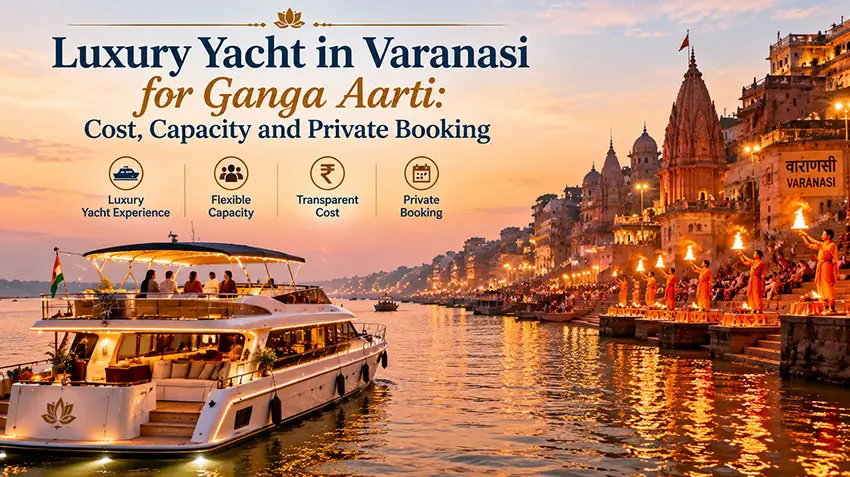
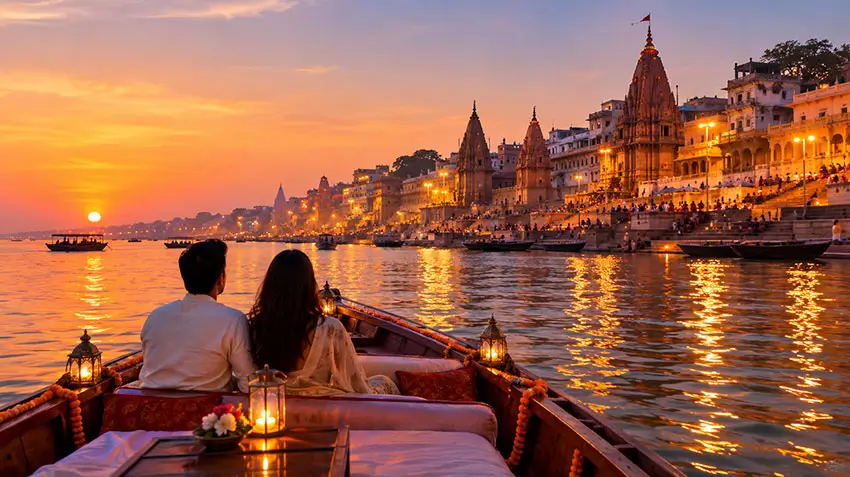
Enjoy the beauty of Varanasi from a private boat as the sun sets over the sacred Ganges. Let us help you plan a memorable evening with scenic river views, peaceful moments, and the option to experience the famous Ganga Aarti.
The most useful habit in Varanasi is to plan your evening backward from the start of the Aarti. The ceremony at Dashashwamedh Ghat begins shortly after sunset, and its exact time changes through the year. In the winter months it starts earlier in the evening, while in the summer it starts later. Your local guide or tour operator will know the current timing, and your boat plan should be built around it.
Once you know when the Aarti begins, count back. You will want around twenty to thirty minutes to settle into a viewing position before the ceremony starts, since the river in front of the main ghat fills up well in advance. Before that, you will want time for the scenic ride along the ghats, usually thirty to forty-five minutes. Add the walk from your car to the boarding point, and you will often find that you need to leave your hotel at least an hour and a half before the ceremony.
Many travellers make the mistake of aiming for sunset. They leave just as the sun goes down, arrive at the river in the dusk, and find the best positions already taken. The ride along the ghats happens in darkness, and the guide has less to show. Starting earlier gives you the golden light on the old buildings, which is one of the finest sights in India.
The ride before the Aarti deserves its own time. As you pass the ghats, you see people bathing, washing clothes, doing yoga, playing cricket on the steps and gathering for evening prayers. You see the long line of old palaces and temples built by rulers from across India. You pass the cremation grounds at Manikarnika, where fires burn day and night. This is the living city, and it is best seen slowly.
The stationary viewing period during the Aarti is different. The boat holds its position, and you watch the priests perform the ritual with lamps, incense and chanting. The ceremony lasts around forty-five minutes. Some guests watch the whole of it from the water, while others prefer to see part of it from the boat and part from the steps.
After the ceremony, many boats leave together, and the river becomes briefly crowded again. If your boat can wait a few minutes, you can enjoy the lit ghats in a calmer mood before heading back. This small pause is often the part of the evening guests describe most warmly.
It also helps to think about what comes after the boat. Dinner in the old city, a walk through the lanes to see the evening temple rituals or a quiet return to your hotel all change how you plan the timing. A clear evening plan, drawn up with your guide, means you are never rushing from one part to the next.
Finally, remember that Varanasi has a morning rhythm too. The sunrise boat ride shows a different city, calmer and more devotional, with pilgrims bathing in the first light. If you have two days in the city, doing both rides gives you a far fuller picture than doing either alone.Seasonal light is worth planning for as well. Between October and March, the evening air is usually clear and the sunset light warm and golden, which makes the ghats glow. In the hot months from April to June, the light is harsher until late in the day, and the evening breeze on the river is a welcome relief from the heat on land. In winter, some evenings bring mist over the water, which softens the scene and gives the lamps of the Aarti a dreamy quality, though it can also limit how far you can see along the river.
Two main types of boat operate on the ghats in the evening. The traditional wooden rowing boat is paddled by a boatman, moving slowly and quietly along the river. The motorboat is faster, covers more distance and handles a larger group more easily. Each suits a different kind of traveller.
The wooden boat has great charm. You hear the water against the hull, the oars dipping and the sounds of the ghats carrying across the river. The pace is gentle, which suits the evening mood. For couples and small groups who want a traditional experience, a wooden boat often feels most authentic. It also lets your guide talk without having to raise their voice over an engine.
The limits of a wooden boat are distance and speed. A rowing boat cannot cover a long stretch of the ghats before the Aarti without starting very early. If you want to see the southern ghats around Assi and then reach Dashashwamedh in time for the ceremony, you may need a motorboat. Wooden boats also tend to have simpler seating, often wooden planks with cushions, which may not suit guests with back or knee problems.
The motorboat offers efficiency and often more comfort. It can take you further along the river, deal better with current and hold its position more easily among other boats. Larger motorboats may have proper seats, shade and space to move around. For families, older travellers and groups of more than four or five, a motorboat is usually the more practical choice.
The trade-off is noise. An engine changes the atmosphere, especially during the quiet moments before the ceremony. Good boatmen will cut the engine once in position, but the approach and departure will not be silent. Some guests do not mind this at all, while others find it breaks the spell.
A useful approach is to match the boat to the route. If you plan a short ride focused on the main ghats and the Aarti, a wooden boat works beautifully. If you want a longer route, a larger group or more comfort, choose a motorboat. Some operators offer a middle option, such as a larger wooden boat with an outboard motor that can be switched off near the ghats.
Mobility needs to be considered for either type. Boarding a boat on the Ganges usually means stepping down from the ghat onto a moving deck, sometimes across another boat. Ask how boarding works at your ghat and whether the crew can help anyone who is unsteady.
Whichever boat you choose, confirm that it is reserved for your party alone. A private boat should not have other passengers added at the last minute, and the confirmation should say so clearly.Comfort on the water is simple to improve with a little preparation. A light shawl or jacket is useful from November to February, when the temperature drops quickly after sunset. A small cushion helps on a wooden seat. Mosquito repellent is useful in warmer months. Comfortable shoes with good grip make the walk down the ghat steps and the boarding far easier, especially after dark when the stone can be uneven and damp.
Make your Varanasi visit truly special with a customized travel experience featuring a private evening boat ride, heritage walks, spiritual landmarks, and unforgettable views of the city’s historic ghats.
Evening boat prices in Varanasi vary widely, and understanding what drives them helps you judge whether a quote is fair. Private wooden boats commonly start at around ₹1,500 to ₹3,000, while motorboats often begin at around ₹3,500. These figures rise with duration, the size and quality of the boat, festival demand and any extras such as a guide, refreshments or decoration.
Duration is the first factor. A short ride of an hour costs less than a two-hour evening that includes a long stretch of the ghats, the full Aarti and time on the water afterwards. When comparing quotes, check how long each one includes and whether the time starts at boarding or at departure from the ghat.
Exclusivity is the second. Shared boats, where seats are sold individually, are much cheaper but give you no control over timing, route or company. A private boat costs more but lets you set the pace and bring only your own group. For most luxury travellers, the extra cost is well worth it.
Demand is the third factor, and it can change prices dramatically. On ordinary evenings, rates are fairly stable. On festival nights, such as Dev Deepawali in November, prices can multiply, boats sell out and river traffic becomes intense. Other holy days and long weekends can also push demand up. If your visit falls on a busy date, book early and expect to pay more.
A cheap quote is not always a good deal. A very low price may mean a shorter ride, a less comfortable boat, a later departure or a shared boat described as private. When the price seems too good, ask what is included and compare it carefully with other quotes.
Extras should be listed separately. A guide, refreshments, flowers, candles for the traditional floating lamps, a photographer or hotel transfers can all add to the cost. Seeing each one itemised lets you decide which are worth paying for.
Payment and cancellation terms matter too. Ask whether you pay in advance or on the evening, what happens if the river is closed and whether the booking can be moved to another date. During the monsoon, when water levels rise, boat operations may be restricted for safety, so flexible terms are especially valuable in those months.
The price that represents good value is the one that matches the evening you want. For a couple wanting a quiet, traditional experience, a private wooden boat for ninety minutes may be ideal. For a family wanting comfort and a longer route, a larger motorboat with a guide may be worth the higher cost.
It helps to think about value in terms of the whole evening rather than the boat alone. A slightly more expensive boat that leaves at the right time, holds a good position and stays on the water after the ceremony may give you twice the experience of a cheaper boat that runs late and returns immediately. When you frame it this way, the real question becomes which quote protects the timing and the calm of the evening.
Varanasi is one of the oldest continuously inhabited cities in the world, and almost every step of its riverfront has a story. Without explanation, the evening ride is beautiful but confusing. With a good guide, it becomes a lesson in faith, history and daily life that stays with you long after you leave.
A guide can explain the different ghats and who built them, the meaning of the rituals you see on the steps, the beliefs around death and cremation at Manikarnika, and the significance of the Aarti itself. They can answer questions as they come up and help you understand what is happening without intruding on the moment.
Guides also manage the practical side. They meet you at the hotel or car, walk you through the lanes to the right ghat, find your boat among many others and handle any conversation with the boatman. On a crowded evening, this can save a great deal of time and stress.
The best guides connect the boat ride with the rest of the city. Before the boat, they might take you through the old lanes, past small shrines and sweet shops, to the Kashi Vishwanath temple area. After the Aarti, they might suggest a place for dinner or a short walk through the evening markets. The boat ride then becomes one part of a well-shaped evening rather than an isolated activity.
Guides also help with etiquette. They can remind you not to photograph cremations, explain when it is appropriate to take pictures during the Aarti and help you buy and float a small leaf lamp on the river if you wish. These small moments show respect and often become personal memories.
Language matters too. If you do not speak Hindi, a guide can speak with boatmen, priests and local people on your behalf and translate conversations. This opens up small interactions that would otherwise be impossible.
When booking a guide, ask about their background and experience. Guides who are approved by the tourism authorities and have long experience in Varanasi are usually the most knowledgeable. Some specialise in history, others in religion or culture, so tell your tour operator what interests you most.
Luxury Private Tours Of India pairs private boats with experienced local guides as part of its Varanasi journeys. We plan the timing around the Aarti, choose the right boat for your group, confirm the meeting point and keep a backup plan ready for weather or river restrictions. The goal is an evening that feels personal, calm and meaningful.
Some travellers also like to see the smaller Aarti at Assi Ghat, at the southern end of the main riverfront. It is less crowded than Dashashwamedh and has a more local feel. A guide can suggest whether it suits your evening, or whether it is better seen as part of a separate visit. Knowing the options helps you shape a Varanasi stay that matches your own interests.
Private wooden boats commonly start at around ₹1,500 to ₹3,000, while motorboats often begin at about ₹3,500, rising with duration and demand.
A wooden boat is quieter and more traditional. A motorboat covers more distance and suits larger groups or guests who need more comfort.
Usually around forty-five minutes, starting shortly after sunset.
For ordinary evenings, a day or two ahead is often fine. For festival nights, book as early as possible.
High water can lead to restrictions. Ask your operator about the situation for your dates and the fallback plan.
Yes. Small leaf lamps with flowers and a candle are sold near the ghats. Your guide can help you do this respectfully.
Photographing the Aarti is generally accepted, but photographing cremations is not. Your guide will advise you.
Not essential, but highly recommended for first-time visitors. A guide explains what you see and handles the logistics.
Yes. Many visitors watch part of it from the steps or from a nearby terrace, especially if boats are restricted.
Aim to board around an hour or more before the Aarti begins, so you can ride along the ghats in daylight and settle into position.