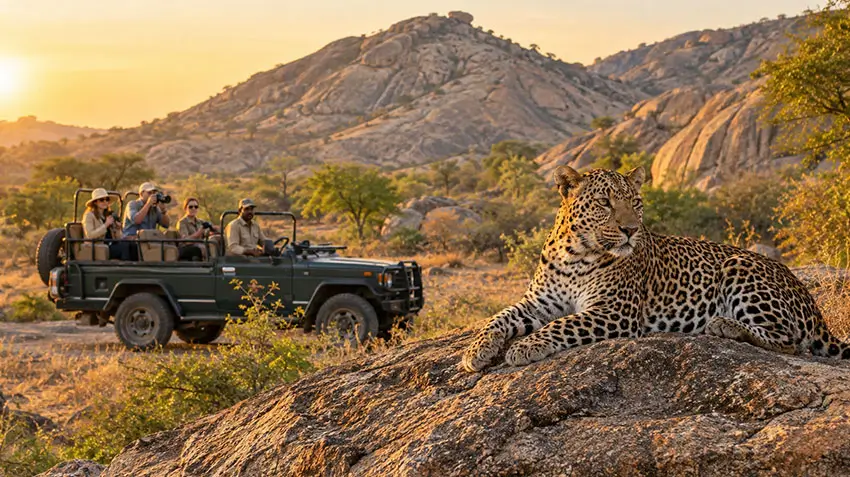
Jawai is not Ranthambore with a different animal. There are no park gates, no numbered zones and no long line of jeeps waiting at dawn. Instead, there are great domes of granite rising from farmland, small villages and temples tucked among the rocks, shepherds in red turbans moving their flocks, and leopards that live alongside all of it. A drive here feels less like entering a reserve and more like being invited into a landscape where people and big cats have shared the same hills for generations.
That difference shapes everything about a Jawai leopard safari. The vehicles, the timing, the way sightings happen and the etiquette in the field all follow their own logic. For travellers who have done safaris elsewhere in India or Africa, Jawai can feel refreshingly personal. For those new to wildlife, it offers one of the best chances in the country to see a leopard in the open, often resting on a rock in the late light.
This guide explains why Jawai uses an open-jeep format, how morning and evening drives differ, what a private jeep should cost and include, and why two drives often make more sense than one. It is written to help you plan a Jawai visit with clear expectations and a well-organised booking.
Jawai sits in the Pali district of Rajasthan, roughly between Jodhpur and Udaipur. The area around the Jawai Dam is dotted with granite hills full of caves and crevices, which give leopards shelter and good lookout points. The dam itself creates a large reservoir that attracts crocodiles, migratory birds and other wildlife, especially in the cooler months.
Unlike a national park, Jawai is a lived-in landscape. The Rabari herders, known for their bright turbans and long association with the land, graze their animals in the same hills where the leopards live. Temples sit on rocky outcrops, some of them with leopards seen nearby. This coexistence is one of the most remarkable things about Jawai and a big part of why visitors find it so memorable.
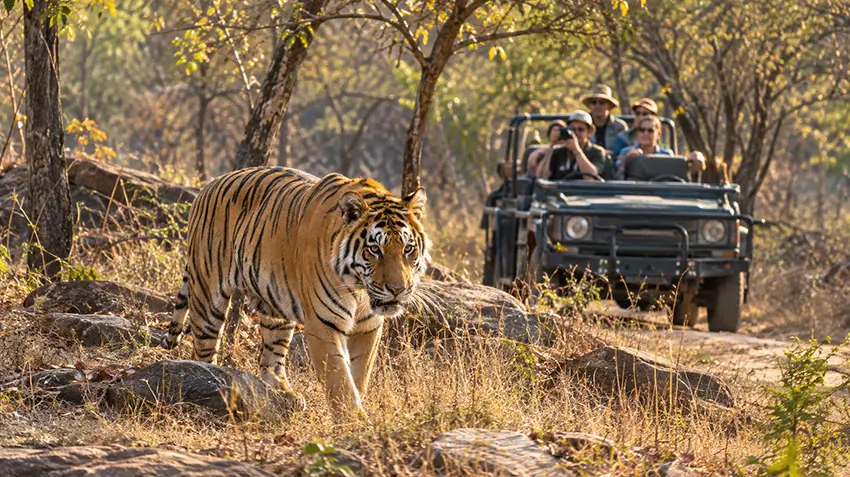
Because of this setting, safaris here use open jeeps that drive along village roads, farm tracks and paths at the base of the hills. The aim is usually to find a vantage point with a clear view of a rocky hill where leopards are known to rest, then wait quietly as the light changes. Sightings often happen at a distance, with the leopard on a ridge or at the mouth of a cave, so binoculars and a good zoom lens are very useful.
The driver and guide are central to the experience. Local knowledge matters more here than in many parks, because leopards move between hills and there are no fixed routes. Experienced drivers know which outcrops are active, which ones have mothers with cubs and where a cat was seen the previous evening. Many work closely with local trackers and villagers who share information about recent movements.
Current private products commonly quote around ₹4,000 to ₹4,500 per jeep for a drive of about two and a half to three hours, for up to six passengers. This is a guide figure, and prices vary with the operator, the season, the level of guiding and whether pickup from your hotel is included. Some luxury camps include safaris in their room rates, while others charge separately.
Because Jawai does not use a zoned permit system like Ranthambore, the booking process is usually simpler. Most safaris are arranged through your hotel or camp, or through a tour operator working with trusted local drivers. You should still carry identification, and it is sensible to ask whether any local rules or fees apply to your dates.
No ethical operator can promise a leopard sighting. Jawai has a strong reputation, and many visitors are fortunate, but wildlife behaviour is never predictable. What a good booking offers is a suitable vehicle, an experienced driver and guide, enough time in the field and honest information about the conditions.
The open-jeep format also shapes how you should behave. Staying seated, keeping voices low and following the driver's instructions help keep both visitors and animals calm. Crowding a leopard, shining lights at night or driving close to homes and temples damages the balance that makes Jawai special.
It is also worth understanding why leopards are so visible here. In dense forest, a leopard can vanish within seconds. In Jawai, the granite hills are largely bare, and the cats like to rest on high rocks where they can watch the land below and catch the warmth of the sun. That habit, combined with years of relatively peaceful coexistence with the villagers, means leopards here are often relaxed enough to stay in view for long periods. Visitors sometimes watch the same animal for half an hour or more, which is rare in most parts of India.
The local community is part of that story. Many Rabari families regard the leopards with a mix of respect and acceptance, and losses of livestock are often tolerated rather than avenged. Responsible tourism supports this balance by bringing income to the area. Choosing operators who employ local people, pay fair wages and follow sensible rules in the field is one of the simplest ways to make sure your visit helps rather than harms.
Discover the rugged beauty of Jawai, Rajasthan, on a private jeep safari through its dramatic granite hills and leopard territory. Enjoy an exciting wildlife adventure, explore the natural landscape, and experience the thrill of spotting leopards in their natural habitat.
Jawai safaris run around the best light of the day, at sunrise and in the late afternoon until sunset. The exact departure times move with the season, earlier in summer and later in winter, so your hotel or operator will confirm the timing for your dates.
The morning drive usually leaves before sunrise. You drive out in the cool air as the sky begins to lighten, then settle at a vantage point as the granite turns from grey to gold. Leopards are often active in the early hours, returning to their rocks after a night of hunting or moving between hills. The soft light is excellent for photography, and the air is usually calm and clear.
The evening drive begins in the afternoon and runs until dusk. As the heat of the day eases, leopards often emerge from their caves to rest on warm rocks, groom or watch the surrounding land. The late light gives the hills a deep orange glow, and silhouettes against the sunset can make striking images. Many visitors find the evening drives especially atmospheric.
Temperature varies a great deal through the year. From November to February, mornings can be quite cold in an open jeep, and a warm jacket, hat and gloves are useful. Afternoons are pleasant. From March onward, days grow hotter, and by April and May the middle of the day can be very hot, although the early morning and evening drives remain manageable.
The monsoon, roughly from July to September, turns the landscape green and fills the dam. Some camps close during this period, while others remain open. Rain can affect visibility and road conditions, but the scenery can be very beautiful. If you plan a monsoon visit, check which camps and safaris are operating.
Birdlife adds interest to both drives. The Jawai reservoir attracts many species, with migratory birds arriving in the cooler months. Crocodiles can often be seen basking on the banks. Some drives include time at the dam, which offers a pleasant change of scene from the rocky hills.
Photographers should think about which light they prefer. Morning light is cool and clean, while evening light is warm and rich. Leopards on rocks against a sunset sky are a classic Jawai image, but morning sightings can be just as rewarding. Booking both types of drive gives you the widest range of opportunities.
Comfort matters on both drives. Bring layers, a scarf for dust, sunscreen and water. Many camps provide tea, coffee or snacks during the drive, often served at a scenic stop. Ask what is included when you book.
A short note on what to wear. Neutral colours such as khaki, olive, brown and beige blend better with the landscape than bright clothing. Closed shoes are more comfortable than sandals, since you may step out at a viewpoint or village stop. In winter, a proper warm layer makes the dawn drive far more enjoyable, and in summer, a light long-sleeved shirt protects against both sun and dust better than a T-shirt.
A private jeep means the vehicle is reserved for your party alone. This lets you set the pace, stay longer at a sighting if the driver agrees and avoid sharing the experience with strangers. For couples, families and photographers, a private jeep is usually well worth the extra cost over a shared vehicle.
When you receive a quote, check that it states the duration of the drive, the maximum number of passengers and whether the vehicle is exclusive. A price of ₹4,000 to ₹4,500 per jeep for two and a half to three hours for up to six passengers is a common guide range for private products. Longer drives, specialist guides and extras will increase the cost.
Ask what is included. Hotel pickup and drop-off, a naturalist or tracker, refreshments, binoculars and any local fees can all be part of the price or charged separately. Some luxury camps include a set number of drives in their room rates, which can make budgeting easier.
Seating in the jeep deserves thought. A six-seat jeep with six passengers can feel crowded, especially for photographers with large lenses. If photography is your main aim, consider booking a private jeep for fewer people so everyone has space to move and a clear view.
The quality of the driver and guide varies. Ask whether your driver has long experience in Jawai and whether a separate tracker or naturalist will join you. Experienced guides often know individual leopards, their territories and habits, which greatly improves your chances.
Cancellation terms should be clear. Ask what happens if you cancel, if weather prevents the drive or if you need to change dates. Most operators are flexible, but it is best to confirm before you pay.
Be wary of very cheap offers. A low price may mean a shorter drive, a less experienced driver, a crowded vehicle or pressure to get too close to animals. In a place like Jawai, where the relationship between people and leopards is delicate, responsible operators are worth supporting.
Finally, confirm the pickup time and meeting point. Morning drives often start in darkness, so you want to know exactly when and where the jeep will collect you. A clear plan avoids a rushed start and missed light.
Where you stay also shapes the safari. Jawai has a small number of camps and lodges, ranging from simple guesthouses to high-end tented camps with their own guides and vehicles. Staying at a camp that runs its own safaris usually makes the logistics easier, since pickups are timed to your stay and the guides know the terrain well. If you book safaris separately, make sure the pickup point, timing and contact number are confirmed in writing before you arrive.
Escape into the wilderness of Jawai with a personalized leopard safari experience. Explore rocky landscapes, observe local wildlife, and enjoy a private jeep adventure tailored to your travel plans with Luxury Private Tours of India.
A single drive gives you a taste of Jawai, but it also puts all your hopes on one session. If the leopards are not visible that morning or evening, or the light is poor, you may leave disappointed. Booking at least two drives, ideally one morning and one evening, greatly improves your chances and gives you a fuller picture of the area.
For photographers, two or more drives are almost essential. They allow you to learn how the light falls on different hills, return to a promising location and try again if the first attempt did not work. Leopards often use the same rocks repeatedly, so a location that was quiet one day may be active the next.
Many visitors plan two nights in Jawai, which gives time for three or four drives. This also allows you to enjoy the setting itself, which many camps make the most of with lovely views, good food and a quiet atmosphere. Between drives, you might visit a local village, walk to a temple or simply rest.
Getting to Jawai takes some planning. It is usually reached by road from Udaipur or Jodhpur, with drive times of around two to three hours depending on your starting point. Some travellers include it as a stop between these two cities. Plan your arrival so you can make the afternoon drive on the first day if possible.
Families with children often enjoy Jawai, because the drives are shorter than a full safari day and the landscape is visually exciting. Children tend to love the rocks, the villages and the wildlife. Ask about age limits and seating arrangements before booking.
If you have limited time, one night in Jawai with an evening drive and a morning drive can still work well. This gives you two chances in the best light and fits easily into a wider Rajasthan journey.
Luxury Private Tours Of India arranges Jawai visits with trusted local drivers and naturalists, often combined with stays in Udaipur and Jodhpur. We confirm drive times for your dates, secure a private jeep with the right seating and plan your route so you arrive in time for the best light.
Private products commonly quote around ₹4,000 to ₹4,500 per jeep for about two and a half to three hours, for up to six passengers.
Usually up to six passengers. Photographers may prefer fewer people for more space.
Drives run around sunrise and late afternoon until sunset. Exact times change with the season.
No. It is a lived-in landscape where leopards share granite hills with villages, herders and temples.
Jawai does not use the same zoned permit system. Carry identification and ask your operator about any local rules.
Sightings are common but never guaranteed. Booking more than one drive improves your chances.
Both are good. Mornings are cool with soft light, while evenings often bring leopards out onto warm rocks.
Usually around two to three hours by road, depending on your starting point.
Layers for cold mornings, a scarf for dust, sunscreen, water and binoculars or a zoom lens.
Yes. The shorter drives and dramatic landscape suit many families. Ask about age limits before booking.