On the Ganges, the word yacht covers a lot of ground. It can mean a sleek modern cruiser, a decorated double-deck boat, a comfortable motor launch or simply a larger craft with cushioned seating and a canopy. None of these is wrong, but they are very different things to spend money on. Before you book a luxury yacht in Varanasi, it pays to know exactly what will be waiting at the ghat when you arrive.
The evening Ganga Aarti at Dashashwamedh Ghat is one of the most moving rituals in India. Priests perform a synchronised ceremony with large brass lamps, incense, conch shells and chanting, while crowds gather on the steps and hundreds of boats fill the river in front. Watching from the water gives you a clear view of the ceremony and the lit ghats behind it. A private premium boat adds comfort, space and a calmer way to experience the evening.This guide covers the questions that matter most when booking a premium boat for the Aarti: what kind of craft you are actually paying for, how capacity and seating affect comfort, why boarding time is so important, and what a well-organised private booking should include. It is written for travellers who want the evening to feel special and unhurried, not crowded and rushed.
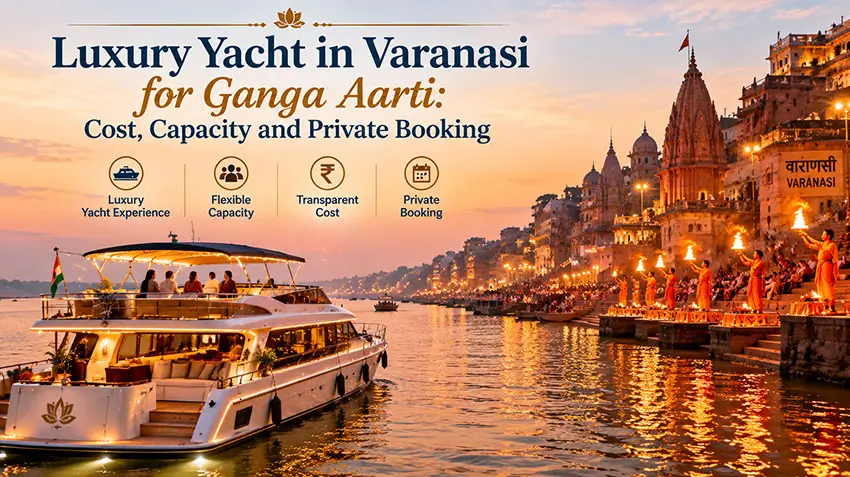
Witness the spiritual beauty of Varanasi’s Ganga Aarti from the comfort of a private luxury yacht. Enjoy a memorable river experience with your family, friends, or special guests. Enquire about yacht availability, pricing, capacity, and private booking options.
The first step is to ask what the boat actually is. In Varanasi, premium river products range from private motorboats with upgraded seating to decorated heritage-style boats and larger craft with upper decks. Operators may use the word yacht for all of them. A clear description of the craft, with its name, type and a recent photograph, tells you far more than the label.
Different boats behave very differently on the river. A small wooden rowing boat is quiet and intimate, moving slowly along the ghats with the sound of oars and water. A motorboat covers more distance quickly but brings engine noise and a little vibration. A larger premium craft can carry more people in comfort, often with shade, better seating and space to move around, but it needs more room to manoeuvre among the many boats that gather for the Aarti.
Seating is one of the most important details. Ask whether the boat has fixed wooden benches, cushioned chairs, sofas, an upper deck, a covered section or an open deck. For older travellers or anyone with back or knee problems, the difference between a hard bench and a proper chair can shape the whole evening. For photographers, an upper deck can give a better angle over other boats.
Safety equipment deserves a direct question. A reputable operator should provide life jackets for every passenger, including children's sizes if needed, and should be willing to show them before departure. Railings, stable boarding steps and a steady crew are all part of a safe evening, especially after dark when the river is busy.
Exclusivity must also be clear. Some boats described as private are private only until more passengers are added. A good confirmation should state that the boat is reserved for your party alone, with the maximum number of passengers and the crew who will be on board.
Premium boats cost more than basic rowing boats, and on festival dates the price rises significantly. Higher-end private charters commonly start at several thousand rupees and can go well beyond that depending on the craft, duration and extras. A higher price is fair when it buys a better craft, more comfort and better service. It is not fair when the operator cannot explain what is different from a standard boat.
Ask how old the boat is and how it is maintained. A newly built premium craft with modern seating and clean facilities is a different product from an older boat that has simply been decorated for the evening. A photograph taken recently, rather than a stock image from a website, is a reasonable thing to request.
Toilets are a practical point that many guests forget. Most boats on the Ganges do not have them, and even some larger craft may not. If anyone in your group needs access to facilities during a two-hour evening, ask directly before booking.
The simplest way to avoid disappointment is to picture the boat before you pay for it. If the operator can describe it clearly, show you what it looks like and answer your questions without vagueness, you are likely dealing with a professional. If the answers stay general, it is worth asking more.
It also helps to know who will be operating the boat. In Varanasi, many boats are run by families of boatmen who have worked the river for generations. Their knowledge of currents, landing points and river traffic is valuable, and a premium charter should combine that experience with good equipment rather than replacing it. Ask who the boatman or captain will be and how long they have worked on this stretch of the river.
Premium boats are often decorated with flowers, fabric, lamps or lights. These touches look beautiful in photographs and add to the atmosphere, but they do not make the evening comfortable on their own. The real comfort comes from how many people are on board, how they are seated and how much space they have.
Ask for the maximum capacity of the craft and then consider how many people you are bringing. A boat that can technically carry twenty people will feel crowded with eighteen, while the same boat with six people will feel spacious and relaxed. For a private evening, choose a boat that gives your group room to move, change seats and stand safely for photographs.
Families with children should think about seating layout. Children often want to stand at the edge and look at the lamps and the crowds. A boat with secure railings and space around the seats is much safer than one where everyone is packed onto narrow benches. Life jackets in children's sizes are essential.
Groups travelling together, such as extended families or friends celebrating an occasion, sometimes need a larger craft. In this case, ask about the layout of the deck, whether everyone can see the ceremony from their seats and whether there is space for a guide to speak without shouting. On a large boat with poor layout, some guests end up watching the backs of other people's heads.
Weather affects comfort too. From November to February, evenings on the river can be surprisingly cold, especially once the sun goes down. A covered area, blankets or a warm drink can make a real difference. In the hotter months of April to June, air movement and shade matter more. During and just after the monsoon, the river can be high and fast, and the authorities may limit boat operations for safety.
Refreshments are a common extra on premium boats. Tea, soft drinks and light snacks are easy to arrange and help make a long evening more pleasant. Ask exactly what is included and whether food is prepared by a trusted kitchen. Given the setting, many visitors prefer to keep refreshments simple and save their appetite for dinner afterwards.
Some premium charters include live music, often a small group playing classical or devotional music on board before the ceremony begins. This can be lovely, but it should not compete with the Aarti itself. Ask how the music will be timed and whether it will stop when the ceremony starts.
Remember that the Aarti is a religious ceremony, not a performance staged for boats. The most comfortable and respectful evenings keep decoration modest, voices low and attention on the ritual. A good premium boat supports this atmosphere rather than distracting from it.
The evening Aarti at Dashashwamedh Ghat usually begins shortly after sunset, with exact timing shifting through the seasons. In winter it starts earlier, and in summer later. Your boat needs to leave early enough to travel along the river, show you some of the ghats and settle into a good viewing position before the ceremony begins.
In practice, this often means boarding around an hour before the Aarti starts, and sometimes more on busy nights. That time is not wasted. The ride before the ceremony is one of the best parts of the evening, with the ghats glowing in the late light, pilgrims bathing, temple bells ringing and the burning ghat at Manikarnika visible from the water. A good guide will explain what you are seeing as you pass.
As the Aarti approaches, boats begin to gather in front of Dashashwamedh Ghat. The river fills quickly, and positions near the front are taken early. A larger premium craft needs more space, so arriving early matters even more. A boat that leaves late may spend the first part of the ceremony trying to find a gap rather than letting you watch in peace.
It is important to be realistic. No operator can guarantee a fixed position on the river. Traffic, current, local rules and the number of boats on a given night all affect where you end up. A trustworthy operator will explain this honestly and aim for a safe, clear view rather than promising the front row.
Getting to the boat is its own small adventure. Vehicle access in old Varanasi is limited, and cars often cannot reach the ghats. Most guests walk the last stretch through narrow lanes or along the riverbank, sometimes down steps to the boarding point. Ask how much walking is involved and how many steps there are, especially if anyone in your group has limited mobility.
The boarding ghat may change according to river level, crowding and traffic control. A good booking includes a named local contact who will meet you at a clear point and walk you to the boat. Without this, you may find yourself searching for the right boat in the dusk among hundreds of others.
Festival nights need special planning. Dev Deepawali, usually in November, sees the ghats lit with countless lamps and draws enormous crowds. Other festivals and holy days can also bring heavy traffic on the river. On these dates, prices rise sharply, boats are booked well in advance and the authorities may apply extra rules. If your visit falls on a festival, book early and allow extra time.
After the ceremony ends, many boats leave at once. A premium craft that stays on the water for a while afterwards lets you enjoy the lit riverfront calmly while the crowds disperse. This short quiet period is one of the most beautiful moments of the evening, and it is worth asking whether your charter includes it.Etiquette on the river is worth a quick note. Photography of the Aarti from a boat is generally accepted, but the cremation ghats are a different matter. At Manikarnika and Harishchandra, families are saying goodbye to loved ones, and photographing the cremations is considered deeply disrespectful. A good guide will remind you of this as you pass. Keeping voices low and flash photography off during the ceremony also helps everyone around you enjoy the moment.
Make your Varanasi visit special with a personalized Ganga River experience. Explore private yacht and boat options, compare capacities, and find a suitable arrangement for your group. Contact our travel team to plan your preferred timing and booking.
A well-organised premium booking should read like a simple plan for the evening. It should name the craft, confirm exclusive use, state the maximum capacity and list the boarding ghat, the meeting time and the local contact. It should also describe the route, the duration and what happens after the ceremony.
The price should be quoted per boat, not per person, unless the operator clearly sells individual seats. Ask what is included: the craft, the crew, a guide, refreshments, decoration, music and any hotel transfers. Extras such as flowers, musicians, photographers or special food should be listed separately so you can decide which ones you want.
Weather and river conditions can change plans. During the monsoon, typically from July to September, the Ganges can rise sharply, and the authorities may restrict or suspend boat operations. Fog in winter can also affect visibility. A professional operator should explain what happens if the river is closed on your chosen evening, whether you can move the booking to another date and how refunds are handled.
It helps to have a backup plan. If boats cannot operate, you can still watch the Aarti from the ghats or from a rooftop terrace overlooking the ceremony. A good guide or tour operator will have arrangements in place so the evening is not lost entirely.
A private guide adds real value to a premium boat evening. Varanasi is dense with meaning, and without explanation much of what you see from the river can be hard to understand. A knowledgeable guide can explain the ghats, the rituals, the history of the city and the Aarti itself, and can manage the logistics of meeting, boarding and returning so you can simply enjoy the evening.
Cancellation terms should be clear before you pay. Ask what happens if you cancel, if the weather turns or if the authorities close the river. For festival bookings, terms are often stricter, so read them carefully.
Many travellers combine the evening boat with a morning ride at sunrise, when the river is calmer and the ghats are full of pilgrims bathing and praying. A premium boat for both sessions gives two very different views of the same city and is one of the best ways to understand Varanasi in a short stay.
Luxury Private Tours Of India arranges premium river experiences in Varanasi as part of wider journeys through northern India. We confirm the craft, the boarding point, the guide and the timing, and we keep a backup plan ready for weather or river closures. Our aim is a calm, comfortable evening that lets you focus on the ceremony rather than the logistics.
When comparing quotes, place them side by side and check the same details in each one: craft type, exclusivity, capacity, duration, boarding ghat, guide, refreshments and cancellation terms. Two quotes that look far apart in price often turn out to describe quite different evenings. Once you line them up, it is usually easy to see which one offers real value and which one relies on the word luxury to justify its price.
Prices vary by craft and duration. Premium private charters commonly start at several thousand rupees and rise for larger boats, extras and festival dates.
It is used loosely for anything from an upgraded motorboat to a larger decorated craft. Ask for the exact boat type and a recent photograph.
It depends on the craft. Ask for the maximum capacity and choose a boat that leaves plenty of room for your group.
Usually around an hour before the ceremony, sometimes earlier on busy nights, so you can travel along the ghats and settle into position.
No. River position depends on traffic, current and local rules. A good operator aims for a safe, clear view without making false promises.
Most boats do not have one. Ask directly if this matters for your group.
High water can lead to restrictions or suspensions of boat operations. Ask about the fallback plan and refund terms.
Usually yes, with life jackets in the right sizes, secure railings and careful supervision. Ask about safety equipment before booking.
Yes. Dev Deepawali and other major festivals bring much higher prices and heavy crowds. Book well in advance.
Yes. A guide explains the ghats and the ceremony and manages the meeting and boarding, which makes the evening far easier.