
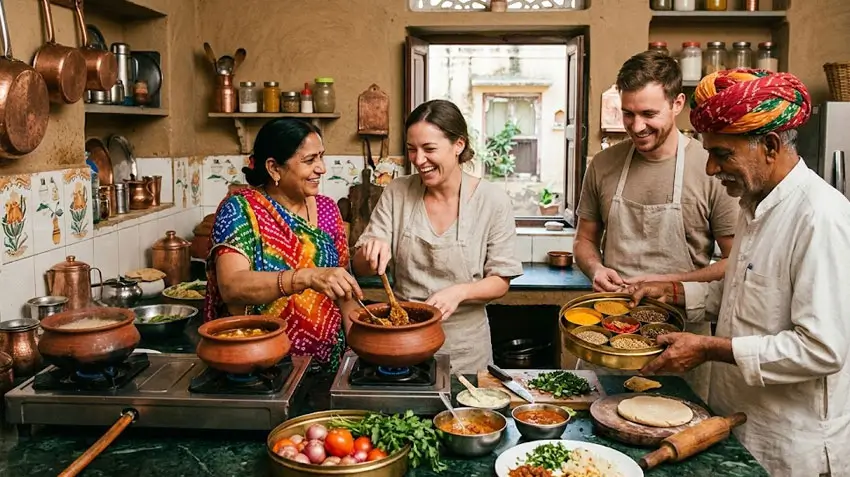
A private cooking class in Jaipur gives foreign travellers access to a side of the city that cannot be understood through forts, palaces and sightseeing alone. Jaipur is famous for Amber Fort, City Palace, Hawa Mahal and its historic bazaars, but daily life in the city is equally shaped by home kitchens, family recipes, seasonal ingredients and food traditions passed from one generation to another. For travellers who want a more personal cultural experience, spending a few hours cooking with a local family can reveal far more about Rajasthan than simply ordering a traditional meal in a restaurant.
The strongest cooking experiences are not designed as short demonstrations where visitors sit in front of a stove while someone else prepares dinner. A genuinely good Jaipur family cooking class should be interactive from the beginning. Guests should have the opportunity to understand the ingredients, handle spices, prepare vegetables, knead dough, roll breads, observe tempering techniques and take part in the final cooking process. The host should explain what is being done and, more importantly, why it is being done in a particular way. This is where the experience becomes educational rather than decorative.
A private format is particularly useful for international travellers because Indian food can raise many questions. Visitors often want to know why whole spices are heated before other ingredients, how garam masala differs from individual spices, why ghee is used in one dish but oil in another, or how families adjust chilli levels without removing flavour. In a large group class there may not be enough time to address these questions properly, whereas a private cooking experience in Jaipur allows the host to adapt the pace around the guests.
The family-home setting also makes the evening feel different from a normal tourist activity. Guests may have tea with the host before entering the kitchen, hear stories about how certain dishes are prepared during festivals, learn which recipes are eaten regularly and which are reserved for special occasions, and finally sit down to eat the food they helped prepare. For couples, families and small private groups, this can become one of the most memorable evenings of a Rajasthan journey.
However, the quality of cooking classes in Jaipur varies considerably. Some are genuinely family-run, some operate more like professional studios and others are heavily commercialized experiences that combine a small amount of cooking with shopping or sales. Travellers therefore need to check the format carefully before booking. The right class should match the level of authenticity, comfort, hygiene and personal interaction expected from a premium private experience.
An authentic family cooking class in Jaipur should provide more than a list of recipes. The real value comes from seeing how food fits into everyday family life. A good host will usually begin by introducing the ingredients and explaining how Indian kitchens organize spices, grains, lentils and fresh produce. Instead of simply presenting a prepared spice mixture, the host may explain the role of cumin, coriander, turmeric, mustard seeds, red chilli, asafoetida or garam masala and how different combinations create completely different flavours.
This is especially useful for foreign visitors because Indian home cooking is often very different from the richer food served in restaurants. Restaurant gravies can use more cream, butter, oil and pre-prepared masalas, while family cooking is often simpler and lighter. Lentils, vegetables, fresh breads and yoghurt-based accompaniments can form the centre of the meal without the heavy sauces that many travellers associate with Indian cuisine. A private class allows visitors to see this difference directly.
The cooking itself should be hands-on. Guests may help prepare dough for chapati, chop vegetables, make a simple chutney, stir a dal or learn how a tempering is added at the end of cooking. The host should not complete the entire meal in advance and then allow visitors to perform only one token task. For a private class to feel worthwhile, travellers should participate in several stages of the process.
An authentic experience should also retain some flexibility. If the guest is particularly interested in Rajasthani food, the host should be able to include at least one or two regional dishes rather than offering only a generic North Indian menu. Similarly, a vegetarian family should be able to enjoy a completely vegetarian session without feeling that the menu is limited.
The menu of a Jaipur cooking class for foreign travellers can vary widely, but a balanced session should ideally include dishes that teach different techniques rather than several similar curries. For example, a lentil dish can introduce pressure cooking and tempering, a vegetable preparation can demonstrate spice layering, a bread can teach dough handling and a dessert can show the use of milk, nuts or semolina.
Dal is frequently included because it is central to Indian home cooking. Guests can learn how lentils are washed, cooked and then finished with a hot tempering of spices. Watching this final stage is particularly useful because the aroma changes instantly when cumin, garlic, chilli or other ingredients hit hot ghee or oil. What appears to be a simple bowl of lentils becomes a lesson in how Indian flavour is built.
Breads are another popular part of the experience. Learning to prepare roti, chapati or paratha is usually entertaining because the process looks easier than it actually is. The host can demonstrate how much water is required for the dough, how long it should rest and how to roll it evenly. Travellers often enjoy attempting to make a perfectly round chapati, even if the result is less than perfect.
Vegetable dishes may include aloo gobi, seasonal mixed vegetables, paneer preparations or dry-style sabzis commonly eaten at home. Paneer is often included because it is familiar to international guests, but a stronger class should also introduce at least one dish that reflects local or regional cooking rather than repeating restaurant favourites.
Travellers specifically interested in traditional Rajasthani cooking in Jaipur can request dishes such as gatte ki sabzi, ker sangri, dal baati churma or laal maas when appropriate. These dishes do not all fit easily into a short class because some require lengthy preparation, but a good host can either focus the menu around them or prepare certain components in advance while still explaining the complete process.
Desserts can include kheer, halwa or another simple homemade sweet. Again, the objective should not be to prepare the largest possible number of dishes. Four or five dishes taught properly are more useful than a rushed ten-dish menu where most of the cooking is done by the host.
A proper private cooking class in Jaipur should generally be given enough time to feel relaxed. Around three to four hours is a sensible duration when the experience includes introductions, ingredient explanation, hands-on preparation, cooking and the final meal. Anything substantially shorter can still work, but the host may need to prepare several elements in advance.
Evening classes are especially popular because the cooking session naturally leads into dinner. Guests can arrive in the late afternoon, spend time learning the recipes and then eat together after the dishes are finished. This format works well for couples and small groups because there is no need to rush back into sightseeing afterwards.
Morning classes can also be excellent, particularly for families travelling with children or guests who prefer not to stay out late. They may begin after breakfast and finish with an early lunch. The atmosphere is often calmer, and the host has more time to explain the recipes before the rest of the day becomes busy.
Travellers should avoid squeezing the class into an already overloaded sightseeing schedule. It is technically possible to visit Amber Fort, City Palace, Jantar Mantar, Hawa Mahal and then rush to a cooking class, but the experience becomes less enjoyable when guests arrive tired. A better approach is to combine the class with a lighter sightseeing day and allow time to return to the hotel before the evening session.
If the class includes a market visit, the total duration can extend to four or five hours. That additional time is worthwhile when the market portion is genuinely educational rather than a shopping excursion.
The price of a private cooking class in Jaipur depends on whether the experience is held in a family home or professional studio, the number of guests, the menu, the duration, the inclusion of transport and whether a market visit is part of the programme. Foreign travellers should expect considerable variation between simple home sessions and premium private experiences.
For a well-organized private class, a practical higher-side budget can be around ₹2,500 to ₹5,000 per person. A premium experience that includes private hotel transfer, a longer session, a market visit, a more extensive menu or enhanced hosting can move into the ₹5,000 to ₹8,000 or more per person range.
Some hosts quote a minimum price per booking rather than a strict per-person rate. This is common for couples because the host is dedicating several hours to the session regardless of whether two or four people attend. Travellers should therefore ask whether the rate shown online is per person, per couple or per private group.
The final price should also clarify what is included. Some classes include the complete meal, bottled or filtered water and printed or digital recipes, while others charge separately for transfers or add-on market visits. Alcoholic beverages are usually not automatically included and should not be assumed.
A cheaper class is not necessarily better value. A shared session with eight or ten participants may cost less but offer very little individual cooking time. A private class costing more can provide a much stronger cultural and educational experience because the host can spend time answering questions and adapting the menu.
Travellers can usually choose between a family home cooking class in Jaipur and a more formal cooking studio. Both formats can be worthwhile, but they serve different preferences.
A family-home experience generally provides greater cultural intimacy. Guests see how a domestic kitchen works, how ingredients are stored and how a family actually prepares food. Conversation often extends beyond cooking into local customs, festivals, daily routines and family traditions. For travellers who enjoy cultural interaction, this can be the stronger option.
A professional studio can provide greater space and a more controlled environment. Workstations may be larger, equipment can be better organized and hygiene procedures may feel more standardized. This can suit travellers who are nervous about entering a private home or who want a structured culinary lesson rather than a broader cultural experience.
The word "authentic" should not automatically be associated only with a basic home kitchen. A professionally organized family experience can still be genuine, while a supposedly local experience can feel heavily staged. Travellers should judge the quality by the host, the menu, the level of participation and the atmosphere rather than by the setting alone.
For a premium cultural evening, a well-reviewed family-hosted session usually provides the most personal experience.
A Jaipur market and cooking class can add considerable value when the host uses the market visit to explain ingredients rather than to encourage shopping. Travellers can see seasonal vegetables, fresh coriander, green chillies, lentils, grains and the enormous range of spices sold in everyday markets. This helps connect the food prepared later in the kitchen with the way local families actually shop.
A market walk can also help visitors distinguish between everyday food markets and tourist-oriented spice shops. Many travellers see beautifully packaged spices in bazaar stores and assume that is how local households buy them, but daily shopping can look completely different. A knowledgeable host can explain which spices are purchased whole, which are ground and how families judge quality.
The market section should normally remain relatively short. The main purpose of the experience is still cooking. If two hours of a four-hour class are spent visiting multiple souvenir stores, the experience has moved away from its original purpose.
Travellers should ask before booking whether the market visit includes any expected purchases. A genuine host should not pressure guests to buy spices, tea, kitchen utensils or other products.
Senior travellers and guests with mobility limitations may prefer to skip the market entirely because local markets can be crowded and uneven underfoot. The cooking session itself can still provide excellent value without this addition.
Jaipur is particularly well suited to a vegetarian cooking class because Indian home cuisine offers an enormous range of meat-free dishes. A vegetarian guest can easily enjoy a full menu built around lentils, vegetables, paneer, breads, rice, chutneys and desserts without feeling that important elements are missing.
Vegan travellers need to communicate their requirements in advance because dairy appears frequently in Indian cooking. Ghee, butter, yoghurt, cream and paneer are all common. Many dishes can be adapted by using vegetable oil, avoiding paneer and replacing yoghurt-based components, but the host needs time to prepare the correct ingredients.
Gluten-free travellers require more detailed discussion. Wheat flour is central to many breads, so chapati, roti and paratha are normally unsuitable unless a special flour is used. Rice, lentils and many vegetable dishes can be naturally gluten-free, but a domestic kitchen may still contain wheat flour and cross-contact is possible.
Serious food allergies should always be disclosed directly and clearly. A home cooking experience is not necessarily able to provide the completely isolated preparation conditions available in a specialist commercial kitchen. If a guest has a severe nut, dairy or gluten allergy, the host should be asked whether they can safely accommodate it rather than assuming they can.
This is especially important for foreign travellers who may describe a dietary preference as an allergy or vice versa. The host needs to understand whether an ingredient is disliked, avoided for lifestyle reasons or medically dangerous.
Food hygiene is one of the most important concerns for international visitors, and a reputable cooking class in Jaipur for foreign tourists should be comfortable answering questions about it. The kitchen does not need to resemble a five-star hotel, but ingredients should be fresh, surfaces clean and drinking water safe.
Guests should ask whether filtered or bottled water is used where water enters the food directly. Fully cooked dishes naturally present fewer concerns than raw salads or uncooked garnishes, and travellers with sensitive stomachs may prefer a menu centred on hot freshly cooked items.
One advantage of a hands-on class is visibility. Guests can see the ingredients being washed, prepared and cooked instead of receiving a finished plate from an unseen kitchen. This can actually make many travellers feel more confident about food safety.
Fresh vegetables should be handled properly, dairy products stored appropriately and utensils kept clean. A host accustomed to receiving international guests will generally understand these expectations.
Travellers who have recently experienced stomach problems should consider avoiding very rich or extremely spicy menus. The host can usually reduce chilli without compromising the overall flavour structure of the dishes.
A family-friendly cooking class in Jaipur can be one of the better cultural activities for children because it allows them to participate physically rather than listening to historical explanations for several hours. Tasks such as rolling dough, mixing ingredients or shaping simple breads can keep younger travellers engaged.
The host should know the children's ages before the booking. A class suitable for teenagers may involve more knife work and active cooking, while younger children require simpler tasks and closer supervision.
Open flames, hot oil and heavy pans obviously require caution. Parents should not assume that a family home has the same childproofing as a commercial children's activity centre. The host can manage the cooking process more safely when they know in advance that young guests will be attending.
Duration also matters. A four-hour class may be too long for very young children, especially after a full sightseeing day. In that case, a shorter menu can be more successful.
Families can also request dishes children are likely to enjoy. Making breads, simple paneer dishes or a dessert often works well.
The private format is valuable because the host can slow down, take breaks and adjust the session rather than forcing the family to keep pace with strangers.
For couples, a private cooking experience in Jaipur can provide a refreshing contrast to formal sightseeing. After several days of forts, palaces and long drives, spending an evening in a local home offers a more relaxed rhythm.
The experience can be particularly enjoyable for honeymoon travellers who prefer something personal but not excessively staged. Cooking together naturally creates conversation and humour, especially when both guests are trying to roll breads or identify unfamiliar spices.
Couples should not assume that every family cooking class is designed as a romantic experience. Its appeal comes from cultural interaction rather than candlelit presentation. If a couple wants a special dinner setup or celebration element after the class, that should be requested separately.
For most travellers, the best evening is one where the host is warm, the food is genuinely home-cooked and there is enough time to eat and talk after the cooking is complete.
A family cooking class does not require formal clothing, but guests should dress respectfully and practically. Jaipur can be warm for much of the year, so light breathable clothing works well, provided it is suitable for entering a private family home.
Very loose sleeves can be inconvenient around open flames and should be secured. Long hair should ideally be tied back while cooking. Comfortable trousers, skirts, dresses or casual shirts are usually appropriate.
Some households ask visitors to remove shoes before entering certain areas of the home. Guests should simply follow the host's guidance rather than treating this as unusual.
Travellers attending an evening class after sightseeing may prefer to return to the hotel first rather than arriving dusty or overheated from the day.
The objective is comfort and courtesy rather than strict dress rules.
Entering a private home requires a slightly different approach from entering a restaurant or hotel. The family is hosting guests within a personal space, so normal courtesy matters.
Visitors should ask before photographing family members or private areas of the home. The kitchen and dining table may be part of the experience, but bedrooms and other personal spaces obviously are not.
Children in the household should not automatically be photographed or posted on social media without permission.
Guests may be offered tea, water or snacks before the class begins. Accepting is polite, but there is no obligation to consume something that does not suit dietary requirements.
Conversations about family life, food, weddings and festivals often arise naturally. These can be some of the most interesting parts of the experience. Foreign travellers should simply apply the same social sensitivity they would use when visiting someone's home anywhere else.
An authentic Jaipur family experience should feel like a respectful exchange, not like entering a home purely to collect photographs.
For foreign travellers, the host's ability to communicate in English is important because the experience depends on explanation. A host does not need perfect English, but they should be able to describe ingredients, cooking methods and cultural context clearly enough for guests to follow the process.
Some family experiences involve several members. One person may do most of the cooking while another family member handles English communication. This can work extremely well because guests receive both culinary instruction and conversation.
Reviews can help identify whether communication is easy. Look for comments specifically mentioning explanations, recipes and interaction rather than simply high star ratings.
Travellers hiring a private guide in Jaipur can also ask whether the guide can accompany them, although this is usually unnecessary when the host already speaks good English.
A cooking class should not become a silent demonstration. The discussion is part of what makes the experience worthwhile.
A Jaipur cooking class with hotel pickup is often the easiest option for international visitors, particularly for evening sessions. Residential neighbourhoods can be difficult for first-time visitors to locate, and some family homes are reached through lanes unfamiliar to taxi drivers.
A private transfer removes this uncertainty. The driver can collect guests from the hotel, take them to the host's neighbourhood and wait or return at the agreed finishing time.
Travellers should confirm whether transport is included in the cooking-class price or charged separately.
If the host lives in a narrow residential lane, the vehicle may not reach the exact doorstep. Guests may need to walk a short distance from the nearest accessible road. This should be explained beforehand, particularly for senior travellers.
Late-evening return transport is useful for guests who do not want to arrange a taxi after dinner.
The transfer should remain simple and direct. A cooking-class booking should not automatically include unrequested shopping stops on the way back to the hotel.
A reliable private cooking class in Jaipur should provide enough information before payment for the guest to understand what they are buying. The booking description should state whether the class is private or shared, the approximate duration, the dishes or menu style and whether the meal is included.
Recent reviews are useful when they contain specific details. Comments describing the host's interaction, cleanliness, hands-on participation and menu quality are more informative than generic reviews saying only that the class was excellent.
Photographs can help travellers judge whether the setting matches their expectations. A family home does not need to be luxurious, but it should look clean and suitable for several people to cook comfortably.
Ask how much of the cooking guests actually perform. Some experiences use the phrase "cooking class" for what is mainly a demonstration followed by dinner.
Travellers should also confirm whether recipes are provided afterward. Receiving written or digital recipes can be useful for recreating the dishes at home, although some family hosts teach more informally.
The cancellation policy should be clear, particularly for advance bookings.
A genuine cooking experience should not be used as an excuse to sell unrelated products. Market visits sometimes become problematic when travellers are taken to a spice shop and pressured to buy expensive packaged spices, tea or souvenirs.
Foreign visitors should ask whether any shopping stop is part of the programme. If they want to buy spices, they can certainly do so, but purchasing should remain optional.
The same principle applies to jewellery, textiles and handicrafts. These have no natural reason to be included in a cooking class unless the traveller specifically requests additional shopping.
A strong host earns income from the cooking experience itself rather than relying on commissions from stores.
This distinction matters because it preserves trust. Guests can focus on learning and interacting with the family without wondering whether each recommendation is connected to a sale.
Travellers who specifically want a Rajasthani cooking class in Jaipur should make that request before the session. Many classes automatically teach popular North Indian dishes because international visitors recognize them, but Jaipur offers an opportunity to learn regional food that may not be widely available outside Rajasthan.
Gatte ki sabzi is a strong example because it reflects how Rajasthan's cuisine adapted to a dry climate where fresh vegetables were historically less available. Gram-flour dumplings are prepared and cooked in a spiced gravy, creating a dish very different from standard paneer or vegetable curries.
Ker sangri is another distinctive preparation using desert ingredients associated with Rajasthan. Its flavour and texture are unusual for travellers who have only eaten mainstream Indian restaurant food.
Dal baati churma can provide a broader introduction to traditional Rajasthani dining, although preparing all components properly can require considerable time.
Guests who eat meat may request laal maas, but the host needs to know this in advance because many family cooking classes are vegetarian households.
The best approach is to request one or two genuinely regional dishes alongside simpler breads, lentils or vegetables. This creates a manageable menu while still giving the class a clear Jaipur and Rajasthan identity.
A cooking class works best when it is not treated as something to squeeze into the last available hour. For travellers spending two or three nights in Jaipur, the session can be arranged on an evening following a lighter sightseeing schedule.
One sensible approach is to visit Amber Fort and selected attractions earlier in the day, return to the hotel for a break and begin the cooking experience in the late afternoon. This gives guests enough energy to participate and prevents the day from feeling overloaded.
Another option is to schedule the class on the second evening after travellers have already seen the major monuments. By then, visitors often appreciate doing something that involves local people rather than another formal sightseeing stop.
Families may prefer a morning class followed by lunch, particularly when children become tired in the evening.
The cooking session should not be placed immediately after a long road transfer from Agra or Jodhpur unless the travellers specifically want it. After several hours in a vehicle, most people benefit from some rest before beginning a three-hour activity.
A premium itinerary should protect the quality of the experience rather than trying to maximize the number of activities in a day.
Before confirming the booking, travellers should have a clear understanding of the format. Ask whether the session is fully private or whether other guests may join. Confirm the approximate number of dishes and whether the menu can be customized.
Dietary requirements should be discussed before payment rather than on arrival.
The duration should be stated clearly.
Ask whether the final meal is included and whether drinks are provided.
If a market visit is advertised, ask how long it lasts and whether shopping is involved.
Confirm whether hotel pickup and return are included.
Ask whether the quoted rate is per person or per private group.
Check whether taxes or service charges are additional.
Travellers should also ask what happens if the host needs to cancel unexpectedly and whether an alternative date or refund is available.
For a private session, the booking confirmation should include a reliable contact number or messaging contact for the host or organizer.
These details may seem simple, but they separate a properly organized experience from an informal arrangement that can become confusing once the traveller is already in Jaipur.
A strong private cooking class in Jaipur should feel relaxed, personal and genuinely connected to the city. Guests should not feel that they are moving through another scripted tourist attraction. They should have enough time to ask questions, make mistakes, taste the food as it develops and understand how each part of the meal fits together.
The host should be willing to explain family traditions without turning the conversation into a rehearsed speech. The kitchen should feel like a place where cooking actually happens, even when the experience has been professionally organized for foreign visitors.
Guests should leave with practical knowledge. They should understand how to build flavour in a dal, why spices are added in a particular order, how dough should feel before rolling and how home-style Indian food differs from restaurant versions.
They should also leave with a clearer impression of Jaipur beyond its monuments.
A city is not only defined by its forts, palaces and markets. It is also defined by the meals prepared every evening inside thousands of homes.
A carefully chosen authentic family cooking experience in Jaipur gives travellers a rare opportunity to enter that world for a few hours, participate rather than simply observe, and carry home something more useful than another sightseeing photograph.