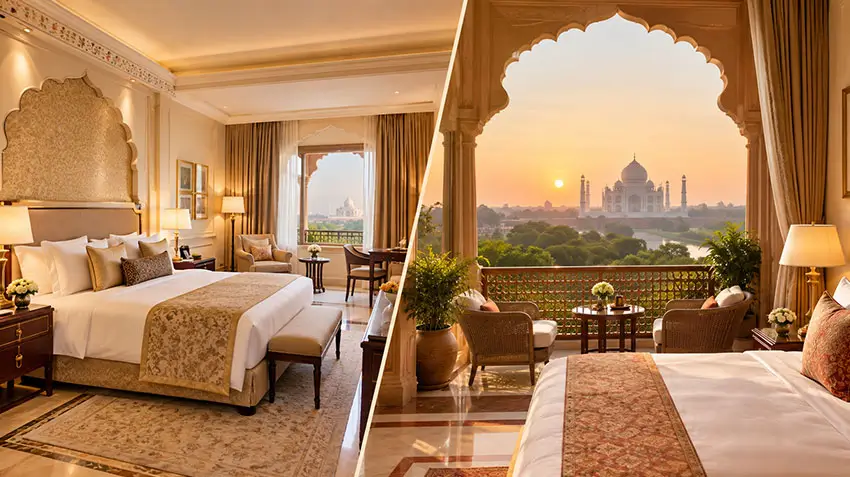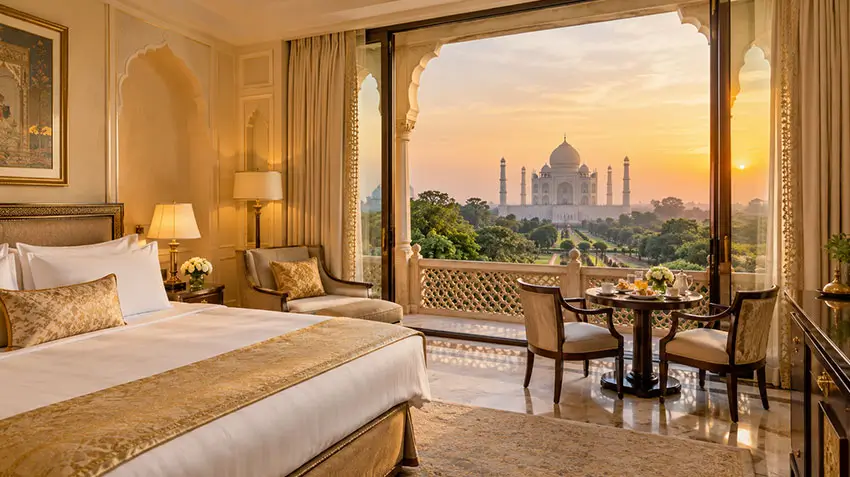

The costly mistake at Amarvilas is not always picking the wrong room. Quite often it is booking one of India's most celebrated hotels and then leaving yourself almost no waking time to enjoy it. Guests arrive after dark, sleep, rush to the Taj at dawn, grab breakfast and leave for Jaipur before lunch. They have technically stayed at Amarvilas, but they have mostly paid for a very expensive bed.
The choice between one and two nights is really a choice about pace. An Oberoi Amarvilas stay of one night can cover the Taj Mahal perfectly well if it is planned with care. A stay of two nights lets the hotel become part of the holiday, with time for the pool, the spa, a long dinner, a second sunrise and the other monuments of Agra that most rushed visitors skip.
This guide walks through what each option feels like on the ground, what a second night actually adds, how to think about the cost against the hours you gain, and which length fits a typical Golden Triangle route. The aim is to help you decide before you book, rather than wishing you had stayed longer as you drive away.

Most visitors reach Agra by road from Delhi. The expressway journey usually takes three to four hours, and more if you leave from the south of the city at a busy time or stop along the way. The Gatimaan Express train is faster, at around one hour and forty minutes between Delhi and Agra, but it runs to a fixed timetable and still needs transfers at both ends. Either way, the arrival time shapes everything that follows.
A well-run one-night plan starts early. You leave Delhi after breakfast, reach Agra around lunchtime, check in, rest, and visit Agra Fort in the afternoon. You return to the hotel for sunset from your room, enjoy dinner, and sleep early. The next morning you are at the Taj at opening time, which is around sunrise, then back at the hotel for breakfast before departing for Jaipur or Delhi. It is a full, satisfying day, and it works well for travellers with limited time.
The trouble starts when the day slips. A late flight into Delhi, a slow departure or heavy traffic can push arrival to the evening. At that point the first half of the plan disappears. You check in after dark, have a late dinner, set an alarm for five and leave soon after breakfast. The room you chose for its view has been seen in daylight for perhaps two hours.
Weather adds another layer of risk. From November to January, fog and haze can hide the Taj at dawn. A one-night stay gives you exactly one morning. If that morning is grey, your sunrise visit may show you a pale shape in the mist and your room view may be much the same. Many travellers accept this risk, but it is worth knowing about before you commit.
Fridays need special care. The Taj Mahal is closed to general visitors on Fridays, so a one-night stay from Thursday to Friday means your only chance to see the interior of the complex is on Thursday afternoon. If you arrive late on Thursday, you may miss it entirely. This is one of the most common planning errors we see, and it is easy to avoid by checking the calendar early.
There is also the question of fatigue. A one-night stop often sits in the middle of a busy route, with a long drive before and after. By the time you reach Jaipur the next evening, you will have spent something like eight hours in a car across two days. For fit, energetic travellers this is manageable. For older guests or families with young children, it can take the pleasure out of the stay.
None of this means one night is wrong. It means one night works best when the arrival is early, the dates avoid Friday, and your expectations are clear. It suits travellers who see Agra mainly as the home of the Taj and want to move on quickly to Rajasthan.
A useful check is to ask yourself what you will do at the hotel itself. If the answer is sleep, eat dinner and look out of the window, one night can be enough. If you picture the pool, the spa, a long lunch and an afternoon on the balcony, you are already describing a two-night stay.
Travellers flying into Delhi late at night should be especially careful. It is tempting to drive to Agra the next morning after only a few hours of sleep, arrive tired and try to fit everything into one day. In practice this usually means a sleepy afternoon at Agra Fort and an early night. If your international flight lands late, a quiet first night in Delhi before heading to Agra makes the Amarvilas stay far more enjoyable, whether you choose one night or two.
It is also worth knowing how the Taj visit itself works on a short stay. Security checks at the gate can take time, especially in peak season, and bags are restricted to small items. The visit inside the complex usually takes two to three hours with a guide. On a one-night stay, those hours come straight out of the limited time you have, so an efficient guide and a clear plan for the gate matter a great deal.

A second night changes the rhythm of your time in Agra more than the numbers suggest. Instead of one rushed day, you get a full day in the middle with no long drive at either end. That day is the one guests usually remember, because it is the only part of the stay where nothing is hurried.
The first gain is a second sunrise. On a two-night stay you can visit the Taj at dawn on one morning and simply watch it from your room on the other. If the first morning is foggy, you have another chance. If both are clear, you have two quite different memories, one from inside the gardens and one from the calm of your own space.
The second gain is time for Agra's other monuments. Agra Fort is the most famous after the Taj, with its red sandstone walls and the marble rooms where Shah Jahan is said to have spent his last years looking toward his wife's tomb. Itmad-ud-Daulah, often called the Baby Taj, is smaller but beautifully detailed and far quieter. Mehtab Bagh, across the Yamuna, gives one of the best sunset views of the Taj from the other side of the river. On a one-night stay most of these are dropped. On a two-night stay they fit comfortably.
Fatehpur Sikri is another option. The abandoned Mughal city sits roughly an hour from Agra and is often visited on the way to Jaipur. With a second night, you can see it as a proper half-day outing in good light instead of squeezing it into a travel day when everyone is already tired.
The third gain is the hotel itself. Amarvilas has a large pool framed by gardens and pavilions, a spa, and restaurants that make full use of the Taj view. On a one-night stay most guests never use these properly. On a two-night stay you can swim in the afternoon, book a treatment, and take a long lunch without looking at your watch.
Dining becomes more relaxed as well. With one night you have one dinner, often a late one after a long day. With two nights you can try more than one restaurant, arrange a private dinner on one evening or simply order in and sit on the balcony. For couples celebrating a special occasion, the second evening is often the one they plan the celebration around.
A second night also helps with shopping and craft visits, if they interest you. Agra is known for marble inlay work, the same technique seen on the Taj. A good guide can take you to see how it is made, without pressure to buy, and still leave time to rest. Squeezing this into a single day usually means cutting something else short.
Finally, a second night lets you leave at a civilised hour. Instead of checking out after a dawn visit and a hurried breakfast, you can sleep in a little, have breakfast on the terrace and depart mid-morning. That small change makes the next leg of the journey feel much easier.
Some couples use the second day for something personal rather than sightseeing. A private breakfast on the terrace, a couples' spa treatment and a late lunch can turn an ordinary itinerary day into the highlight of the trip. Others choose a slow afternoon by the pool and an early evening walk through the hotel gardens as the Taj changes colour. Neither plan involves a car, a queue or a timetable, which is exactly why guests value it.
A second night also helps if something goes wrong. Road closures, a delayed train or a sudden illness can cost you half a day in India without much warning. On a one-night stay, that half day may be the only time you had. On a two-night stay, you still have room to see what you came for.

Amarvilas prices change with the season, with holiday periods and with wedding demand. The cool months are the busiest and most expensive, while summer and the monsoon usually bring lower rates. When comparing one night with two, use a live quote for your actual dates rather than a figure you saw online some time ago.
The first calculation is simple: the cost of the second night, including taxes. That figure can feel large on its own. The more useful calculation is what it buys in hours. On a one-night stay with a midday arrival and a mid-morning departure, you may have around ten waking hours at the hotel, some of them spent at the monuments. On a two-night stay with the same arrival and departure times, you add a full day, often another twelve or more waking hours, much of which can be spent enjoying the property.
Seen that way, the second night often buys more usable time than the first. The first night carries the burden of travel, check-in and early departure. The second night is almost pure holiday. That is why many experienced travellers treat the second night as the better value, even though it costs the same on paper.
It also helps to look at the rest of the trip. If adding a night in Agra means removing a night in Jaipur or Udaipur, you need to compare what each place offers. Jaipur has more monuments and more shopping. Udaipur has lakes and a slower pace. Agra has the Taj and one of the country's best hotels. There is no single right answer, but the decision should be made with the full route in view.
Sometimes the right trade is to take a lower room category for two nights rather than a higher one for a single night. A standard Taj-view room for two nights gives you two sunrises, a free day and the hotel's facilities. A suite for one night gives you more space but little time to enjoy it. For most travellers, time beats square metres.
Meal plans can tip the balance. Some rates include breakfast only, while others include dinner or other benefits. If the two-night rate includes something you would otherwise pay for, the real cost of the extra night falls. Ask your tour operator or the hotel to show the full inclusions for both options side by side.
Cancellation terms matter more on longer stays. A two-night booking on a strict non-refundable rate carries more financial risk if your plans change. If there is any uncertainty in your dates, compare the flexible rates for both options before deciding.
The last piece is energy. Money can be measured easily, but tiredness cannot. A traveller who arrives exhausted in Jaipur after a rushed night in Agra loses some of the value of the next hotel too. A second night at Amarvilas can make the whole trip feel calmer, and that benefit reaches beyond Agra.
There is also a quieter benefit to longer stays at many luxury hotels. Staff get to know you. By the second evening, the restaurant knows your table preference, housekeeping knows how you like the room, and the butler knows what time you want tea. This kind of personal service is part of what you pay for at Amarvilas, and it simply does not have time to develop on a one-night stop.
If the budget really does not stretch to two nights, one night can still be excellent. The key is to guard the hours you have. Arrive early, keep the evening free, choose a date that avoids Friday and set realistic expectations about the weather. Travellers who follow those simple rules usually leave happy, even on a short stay.
The classic Golden Triangle route links Delhi, Agra and Jaipur, often with extensions to Udaipur, Jodhpur, Ranthambore or Varanasi. How long you stay in Agra depends on where it sits in the route and how many days you have overall.
On a short trip of five or six days, one night in Agra is common and usually enough, provided you arrive early and avoid a Friday. The typical plan is two nights in Delhi, one in Agra and two in Jaipur. In this case, choose a good Taj-view room, plan an afternoon arrival and a sunrise visit, and accept that the stay will be focused on the monument.
On a trip of eight to ten days, two nights in Agra becomes a real option. You might spend two nights in Delhi, two in Agra, one at Ranthambore on the way to Jaipur, and two or three in Jaipur. The extra night in Agra gives balance to the route and a rest day between big cities.
On longer journeys of two weeks or more, two nights in Agra is often the wise default. After several busy days in Delhi and before a long drive into Rajasthan, a slow day at Amarvilas helps everyone recover. Travellers on these longer routes also tend to have more interest in the lesser-known monuments that only fit into a two-night stay.
The direction of travel matters too. If you are coming from Delhi by the expressway, an early start makes one night workable. If you are coming from Varanasi by flight or overnight train, arrival times can be less predictable, and a second night gives a cushion. Coming from Jaipur by road usually means a long day with stops at Abhaneri or Fatehpur Sikri, so arrival is often late afternoon.
Families should think about children's energy. A two-night stay lets them swim, play in the gardens and rest between visits, which makes the monuments more enjoyable for everyone. A one-night stay with a dawn start can be hard on younger travellers.
Couples on a honeymoon or anniversary trip almost always benefit from two nights. The extra evening gives time for a private dinner or a quiet moment on the balcony, and the extra morning makes the stay feel like a retreat rather than a stop.
When Luxury Private Tours Of India plans a route, we look at the whole trip before recommending one or two nights at Amarvilas. We check the Friday closure, the likely arrival time, the season and the guests' pace. If one night fits cleanly, we plan it tightly so nothing is wasted. If two nights would make the trip better, we explain what it adds and what it would replace elsewhere.
Yes, if you arrive by early afternoon and visit the Taj the next morning. A late arrival leaves very little time to enjoy the hotel.
A second sunrise, Agra Fort, the Baby Taj, a Mehtab Bagh sunset, Fatehpur Sikri, the pool and spa, and a relaxed departure.
The Taj is closed on Fridays, so you would need to visit on Thursday afternoon. Arriving late on Thursday could mean missing it.
Usually three to four hours by the expressway, depending on traffic and your starting point in Delhi.
The Gatimaan Express takes around one hour and forty minutes, but it runs to a fixed timetable and needs transfers at both ends.
It can. From November to January, dawn fog sometimes hides the Taj. Two nights give you a second chance at a clear morning.
For most travellers, a standard Taj-view room for two nights gives more time and more experiences than a suite for one.
Not at Amarvilas. The second day can be split between lesser-known monuments and the hotel itself, which few guests find too slow.
Trips of eight days or more usually have room for two nights, especially when Agra sits between Delhi and a long drive into Rajasthan.
Yes. A private tour operator can match your arrival, Taj visit and departure to the hotel stay so that the hours you pay for are well used.