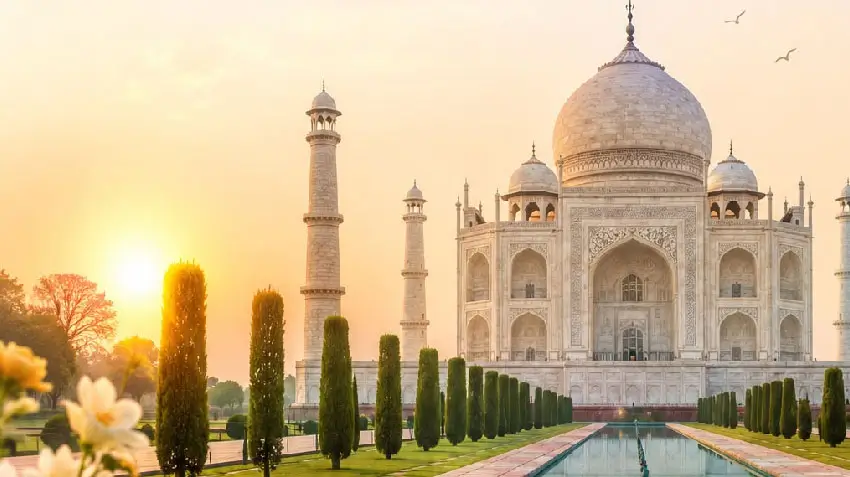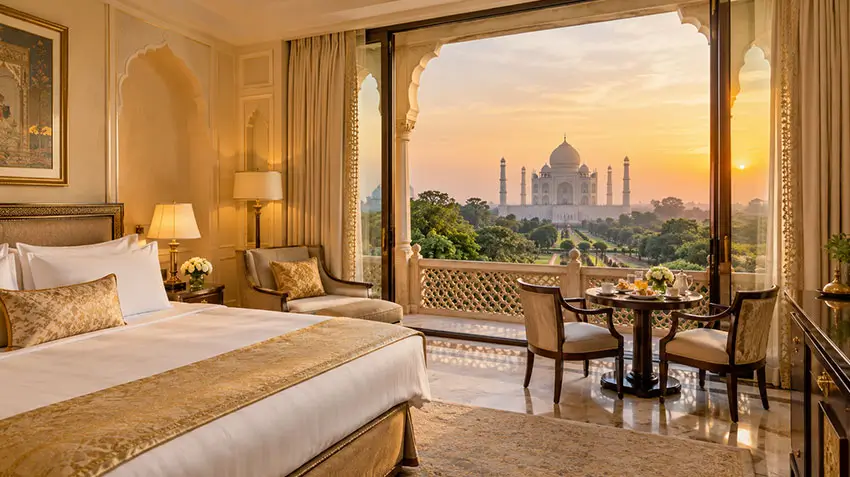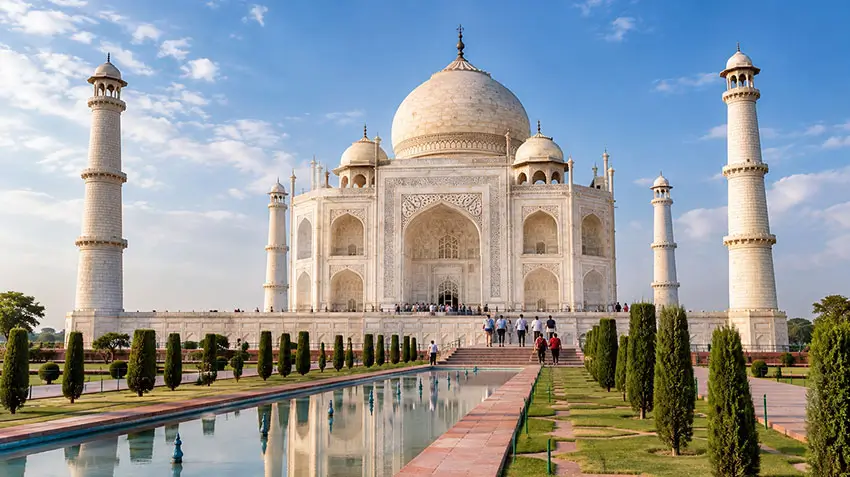
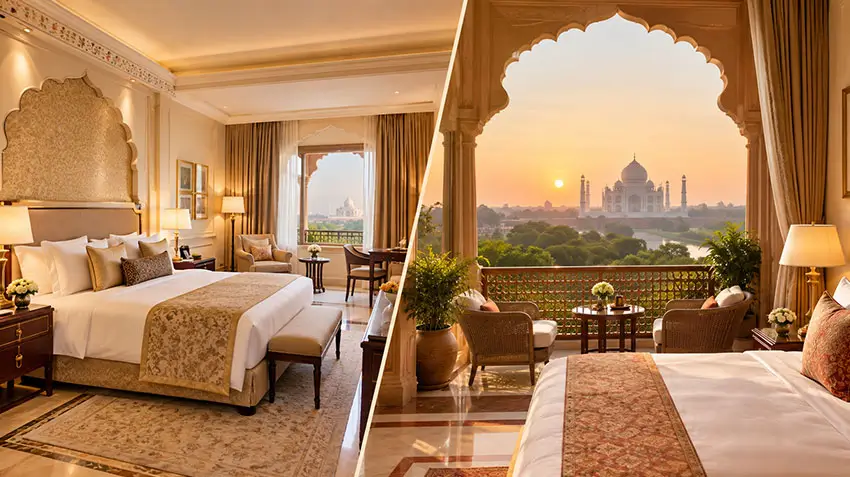
This is a narrow question, and that is what makes it useful. You are not choosing between two hotels or between a room and a grand suite. You are choosing between the Oberoi Amarvilas Premier Room, which already looks at the Taj Mahal, and the same basic room with a private balcony added. The bed, the bathroom standard and the service are broadly similar. What changes is whether you can step outside and sit with the monument in the open air.
That single feature can feel essential to one guest and almost irrelevant to another. This guide looks at the balcony in practical terms: what it adds that a window cannot, how Agra's seasons affect its use, how to think about the price gap and which kinds of travellers get real value from it. By the end you should be able to decide in a few minutes rather than guessing at check-in.
A quick note on names. Hotels sometimes adjust category titles, and resellers occasionally rename them. Always compare the official category names on the hotel's own confirmation, and make sure the word balcony appears clearly in the room type you are paying for.
The published details for the balcony category give around 42 sqm inside and roughly 65 sqm in total, so the outdoor space adds a little over 20 sqm. That is a real sitting area, not a decorative ledge. It is large enough for two chairs and a small table, which means you can take a meal, a drink or a book outside and stay there for as long as you like.
Glass changes how you see the Taj. Inside a room, reflections from lamps and screens sit on top of the view, especially at dawn and dusk when the light outside is low. The frame of the window also cuts the scene into a picture. Outside, the edges disappear. You see the monument as part of a wider scene with the gardens, the sky and the birds, and your eyes can adjust properly to the changing light.
Sound and air matter too. Early mornings in Agra can bring the call of birds from the trees between the hotel and the Taj, and a faint breeze that you simply cannot feel through a sealed window. Many guests describe the balcony as the moment the trip slowed down. That is hard to put a price on, but it is the core of what the upgrade sells.
For photographers the difference is concrete. Shooting through glass means reflections, colour casts and focus problems. Shooting from a balcony gives you a clean line and the freedom to reposition. If you plan to photograph the sunrise, or if a good image of the Taj from your room is one of the things you want to take home, the balcony removes most of the technical frustrations.
The standard Premier Room is still a strong room. You wake up with the Taj in front of you, and you can see it from bed and from the seating area. For many travellers that is more than enough. The balcony does not create the view. It changes how you live with it.
A good test is to imagine the trip without the balcony and ask what you would lose. If the answer is a couple of quiet cups of tea and a few photos, the standard room may be the better purchase. If the answer is the moment you most looked forward to, the upgrade is probably worth pricing seriously.
There is one more subtle difference. With a balcony, the room feels connected to the outdoors even when you are inside. Light moves across the floor differently, the door can be opened for fresh air on a mild morning, and the space feels larger than its interior size suggests. Guests who dislike sealed hotel rooms often value this more than the view itself. If you are someone who always opens the window in a hotel, the balcony category may simply suit the way you like to live, and that is a perfectly good reason to choose it.
Some guests worry that a balcony means less indoor space. At Amarvilas the published figures suggest the interior is broadly comparable between the two categories, with the outdoor area added on top. You are not giving up room inside to gain room outside. Still, it is sensible to ask the reservations team to confirm the interior size of both categories on your booking, because layouts can differ slightly by wing or floor.
Another point that is easy to overlook is how the room feels at night. With a standard room, you close the curtains and the Taj disappears until morning. With a balcony, many guests leave the curtains open and step outside once more before sleeping. It becomes part of the evening rhythm rather than a view you check once and forget. People who have stayed in both often say the balcony made the hotel feel less like a luxury room and more like a private house facing the monument.
Finally, a balcony changes how you share the moment. Couples talk more outside, families gather for a photograph together, friends raise a glass. Those small scenes are often what travellers mention later when they describe their stay, and they rarely happen in the same way around a window.
Agra has three quite different seasons for balcony use, and the time of year you travel will change the value of the upgrade more than almost anything else. Between roughly November and February, mornings are cool and sometimes cold, afternoons are mild and evenings are pleasant with a light layer. This is when a balcony gets the most use across the whole day.
Winter also brings fog. Some mornings the Taj is hidden for an hour or two after sunrise, and on a few days it barely appears. Guests who stay only one night in December or January are taking a real chance with the sunrise view. That does not reduce the value of the balcony, but it does mean the balcony pays off best on a stay of two nights, when you have a second morning if the first one is grey.
March and October are transition months and often very good for balcony use. The fog has lifted or not yet arrived, the light is clearer, and temperatures sit in a comfortable range for much of the day. If you have flexibility in your travel dates, these shoulder months can give you the best balance between weather, visibility and price.
From April to June the heat is serious. Midday temperatures regularly climb very high, and few guests will want to sit outside between late morning and late afternoon. In these months the balcony becomes a dawn and after-dark space. It still has value, especially for sunrise, but that value is concentrated into shorter windows at the start and end of the day.
The monsoon, from about July to September, is less predictable. Rain can come in heavy bursts, followed by clear, freshly washed skies and dramatic clouds over the monument. Some of the most striking Taj views happen in this season, but you need patience and a bit of luck. A balcony is useful because you can step out the moment the rain stops, rather than watching through wet glass.
When you look at your dates, match them against these patterns. A couple travelling in late February with two nights at Amarvilas will likely use the balcony every day. A family arriving on a June afternoon and leaving at dawn for Jaipur will use it for perhaps ten minutes.
Air quality is worth checking in the days before you travel, particularly in November and December. Some years bring long periods of smog to northern India. On those days the Taj can look faint even at midday, and sitting outside may be less pleasant. This is not a reason to avoid Agra, but it is a reason to keep your expectations flexible and to prefer two nights if your trip falls in that window.
Mosquitoes can also be active in the evenings after the monsoon and into early winter. The hotel manages its grounds carefully, but a little repellent makes evenings on the balcony much more comfortable. It is a small practical point, and one that guests often forget when picturing a romantic sunset.
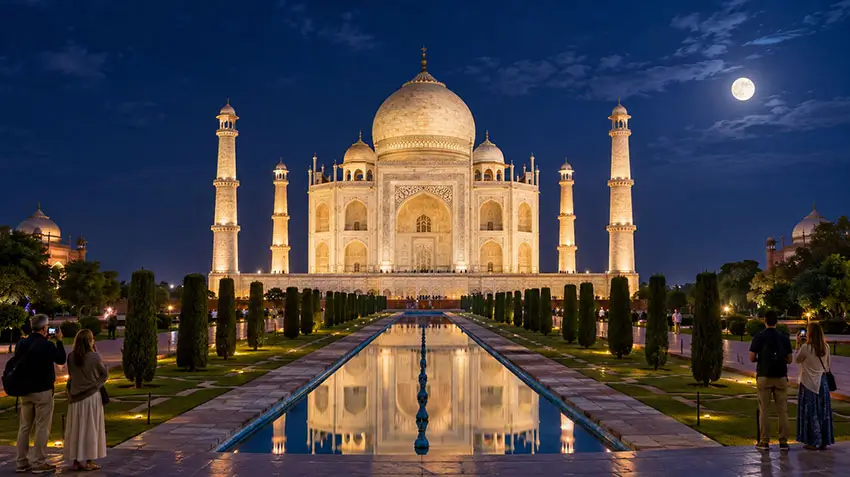
Seasonal events can change the picture as well. The Taj is sometimes open for night viewing around the full moon on selected dates, subject to official rules and limited tickets. If your stay falls near a full moon, a balcony gives you a front-row seat to the moonlit monument even if you do not have a night-viewing ticket. Ask your tour operator whether night viewing is running on your dates, since the arrangement is controlled by the authorities and can change.
Amarvilas prices are dynamic, and the gap between the Premier Room and the balcony category moves with them. On quiet dates the difference may feel modest. During the cooler season, holidays and wedding weeks it can be large. For that reason, it makes more sense to ask for a live quote for your exact dates than to rely on a figure found online.
Once you have both prices, work out the full cost of the upgrade for the whole stay, including taxes. A ₹30,000 difference per night becomes ₹60,000 over two nights before tax, and more once tax is added. That sum is not abstract. It could pay for a private guide for several days, an upgraded vehicle for the whole Golden Triangle, a special dinner in Jaipur or Udaipur, or an extra night somewhere else on your route.
Then count how many hours you expect to spend on the balcony. Be honest. If the plan is a late arrival, a sunrise visit to the Taj and an early departure, you might use it for an hour at most. Divide the upgrade cost by that hour and the number becomes uncomfortable. If you have a free afternoon and a slow morning, you might use it for five or six hours across the stay, and the cost per hour starts to look reasonable for a once-in-a-lifetime setting.
Meal plans can shift the maths. If your rate includes breakfast and the hotel will serve it on the balcony, that becomes a private breakfast facing the Taj every morning of your stay. For many couples that single experience justifies the difference. Ask whether in-room or balcony dining carries an extra charge, and how early it can be served.
Cancellation terms deserve attention as well. Sometimes the balcony category is offered on a stricter rate plan, or the flexible rate costs more. If there is any chance your dates will change, compare the flexible price for both categories rather than mixing a flexible standard room with a non-refundable balcony room.
Finally, remember that the upgrade has an opportunity cost across the whole trip. Money spent on a balcony in Agra is money not spent on a lake-view room in Udaipur or a better safari vehicle in Ranthambore. Luxury travel feels best when the big spending goes to the places you will remember most.
It also helps to separate the emotional value of the upgrade from the practical value. The practical value is hours of use, comfort and privacy. The emotional value is the feeling of having done Agra properly, and the memory of a moment that cannot be repeated easily. Both are real. The mistake is paying purely for the emotional value without checking whether your schedule allows the moment to happen at all.
A simple rule works for most travellers. If you will be in the room for at least one sunrise and one sunset in daylight, the balcony is a fair purchase. If you will see only one of the two, think carefully. If you will see neither in daylight, keep the money for another part of the trip.
Some guests book the standard Premier Room and then ask about an upgrade at check-in. This can work on quiet dates, and the hotel may offer a rate for the change. On busy dates the balcony rooms are often already full, so the strategy is risky if the balcony matters to you. If it is central to the trip, book it from the start.
Honeymoon and anniversary couples are the clearest case. They usually want privacy, time together and a setting that feels special. A balcony breakfast facing the Taj, or a quiet drink outside after dinner, fits exactly what they came for. If this describes your trip, and your stay has at least one relaxed morning or evening, the balcony is likely one of the best uses of your budget in India.
Photographers and keen amateur shooters come next. They will be up before dawn anyway, and a balcony lets them shoot the sunrise, rest, shoot again in the afternoon and capture the dusk without leaving the room. For them the balcony removes glass, reflections and the need to leave the hotel for every attempt.
Travellers who want a rest day in the middle of a long itinerary also benefit. India can be tiring, with long drives and busy days at monuments. A balcony room at Amarvilas turns an afternoon off into something memorable instead of just a nap. If your trip is two or three weeks long, building one slow day here can reset your energy for the rest of the journey.
Families with young children may find the balcony less useful and sometimes a source of worry. Ask about railing height and whether the door can be secured if you are travelling with small children. In many cases a standard Premier Room with the view, plus access to the pool and gardens, serves a family better.
Older travellers should look at practical details. Is there a step down to the balcony? How far is the room from the lift? Is the bathroom layout easy to use? For some guests, a well-located standard room will be more comfortable than a balcony room at the far end of a long corridor.
Business travellers or those on a very tight schedule are the least likely to use the upgrade. If Agra is a one-night stop between meetings in Delhi and a flight from Jaipur, the standard view room will give you the Taj without paying for outdoor space you will not see in daylight.
When you plan the trip with Luxury Private Tours Of India, we look at your full timetable before recommending a category. If we see a late arrival and an early start, we will usually suggest the standard view room and use the savings elsewhere. If we see a free afternoon, we will often suggest the balcony and time your arrival so you reach the hotel with plenty of daylight left.
Solo travellers are an interesting case. A single guest often has more freedom to use the room, because there is no need to agree on plans with anyone else. Some solo travellers treat Amarvilas as a private retreat in the middle of a busy tour, and the balcony becomes the reason for the stay. Others see the hotel as a convenient base for the monument and are happy with the view from inside.
Groups travelling together sometimes mix categories. One couple takes the balcony room and the rest of the party take standard view rooms, then everyone gathers on the balcony for a sunset drink. This spreads the cost, gives the whole group a shared moment and avoids paying for several balconies that would each be used only briefly.
The upgrade decision can also be linked to your wider plans. If Amarvilas is the one splurge on a trip that otherwise uses more modest hotels, the balcony may be the right way to make that splurge count. If you are staying at palaces and resorts across Rajasthan as well, you may want to keep the budget for a lake view in Udaipur or a suite in Jodhpur and choose the standard room in Agra.
Both look toward the Taj Mahal. The balcony category adds private outdoor space of a little over 20 sqm, so you can sit outside with the view.
For many guests, yes. You still wake up facing the Taj. The balcony changes how you enjoy the view rather than whether you have one.
November to March is the most comfortable, with March and October often giving the clearest light. Summer limits use to early morning and evening.
Often it can. Ask the hotel when you book whether balcony dining is available and whether any extra charge applies.
Only if you arrive early enough to use it in daylight or plan a slow morning. For a late arrival and dawn departure, the standard room is usually better value.
They are private to your room, but neighbouring balconies sit nearby. Ask how screened your balcony is if privacy is important.
Ask about railing height and door locks before booking. Some families prefer the standard room for peace of mind.
The difference changes with season and demand. Ask for a current quote for both categories on your exact dates and compare the full-stay total.
If the choice is between one night with a balcony and two nights without, two nights often gives more, including a second chance at a clear sunrise.
Check that the confirmation shows the official balcony category name, bed type, occupancy, taxes and cancellation terms in writing.