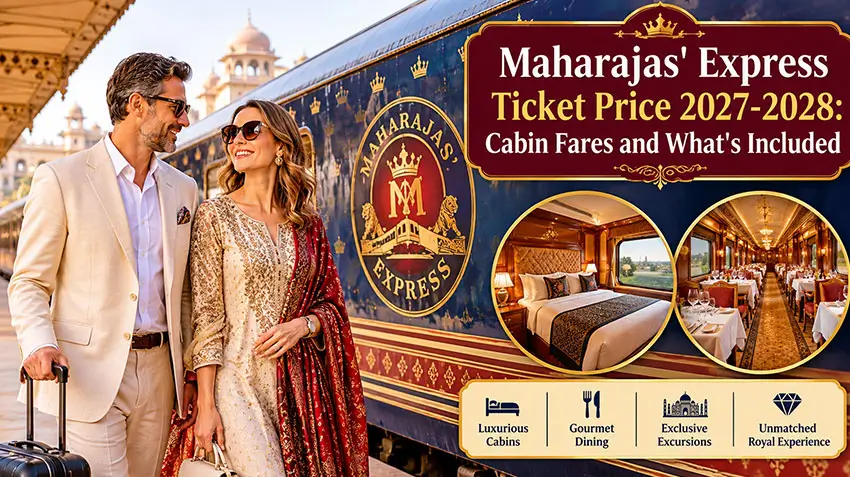
A fare on the Maharajas' Express is not a hotel rate multiplied by a number of nights. It is the price of a complete journey, bundling your cabin, meals, drinks, guided excursions and onboard service into one sum. That is why the numbers can look startling at first glance, and why they only make sense once you read them beside what they cover.
This guide explains the Maharajas Express ticket price for foreign travellers in 2027-28, cabin by cabin. We look at how journey length changes the apparent cost, what the fare includes on and off the train, how single occupancy and GST reshape the budget, and how the train compares with a luxury private itinerary covering similar ground. The aim is to help you understand what you are paying for before you choose a cabin.
As with any large travel purchase, use the figures here as a guide and confirm the current official tariff and terms before paying. Rates, journeys and inclusions can be revised from season to season.
Weather along the route is worth considering when you choose between journeys. The train runs during the cooler months, when most of northern India is pleasant by day. Desert stops can be cold after dark in December and January, while departures near the start and end of the season can bring warmer afternoons. Journeys that include wildlife parks may also be affected by park seasons and opening dates. Checking these details for your chosen departure helps you pack well and set realistic expectations.
The Maharajas' Express runs several set journeys. The longer ones, such as Indian Splendour, Heritage of India and Indian Panorama, cover about a week and visit a string of destinations across Rajasthan and northern India. The shorter Treasures of India journey covers three nights and focuses on the Golden Triangle. Each has its own fare, so the first step is to decide which journey you want.
For the longer journeys, current published fares are roughly $8,400 to $8,800 per person in a Deluxe Cabin, $10,700 to $11,200 per person in a Junior Suite, around $15,600 per person in a Suite and up to about $26,800 in the Presidential Suite. GST at 5 percent is added on top. The range within each category reflects differences between the journeys and seasons.
Because these are per-person figures for the whole journey, a couple sharing a Deluxe Cabin on a long journey would pay around $16,800 to $17,600 before tax. In a Junior Suite, the couple would pay around $21,400 to $22,400. In a Suite, around $31,200. These totals are the real numbers to plan around.
It helps to divide the total by the number of nights to see the nightly equivalent. A couple paying $17,600 for a six-night journey is spending a little under $3,000 per night for the cabin, meals, drinks, excursions and service. Seen this way, the fare looks different from the headline figure, especially once you compare it with the cost of a top palace hotel plus meals, guides and transport.
The shorter Treasures of India journey costs less in total, but the nightly equivalent may be similar or higher, because the fixed costs of the experience are spread over fewer nights. It suits travellers who want a taste of the train within a shorter holiday, or who plan to combine it with other experiences.
Choosing between a long and short journey is partly about budget and partly about pace. The longer journeys offer a fuller picture of India, with more destinations and more time on board. The shorter journey gives you the atmosphere of the train without committing a whole week.
Seasons also affect the fare. The train runs through the cooler months, and prices can vary between departures. Check the fare for your exact date rather than relying on a general figure.
When you compare journeys, write out the total for your party, the number of nights, the destinations covered and the nightly equivalent. This simple table often makes the right choice obvious.
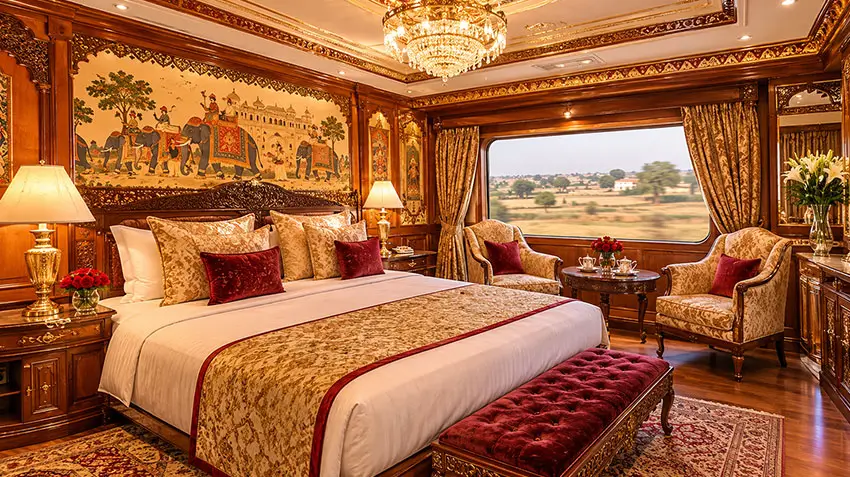
Understanding the four cabin levels helps too. The Deluxe Cabin is the entry category and suits most couples comfortably. The Junior Suite offers more space and larger windows, which many guests enjoy as the landscape passes by. The Suite gives considerably more room, often with a separate sitting area and a more generous bathroom. The Presidential Suite is the train's showpiece, known for occupying a large share of a carriage and offering a level of space rarely found on any train. The price steps between them reflect these real differences in space and comfort.
When choosing, think about how much time you will spend in the cabin. On the longer journeys, there are stretches of travel between destinations when guests rest, read or watch the countryside. The more you value those hours, the more a larger cabin earns its price.
Dreaming of exploring India in royal style? Discover the extraordinary Maharajas' Express luxury train experience, featuring elegant cabins, fine dining, personalised hospitality and unforgettable destinations. Contact our travel experts to explore ticket prices, cabin options and personalised booking assistance for your journey.
The Maharajas' Express fare includes a great deal beyond the cabin. According to the published product, it covers accommodation, meals, a range of beverages and guided off-train excursions at the destinations on your journey. Understanding these inclusions is essential to judging whether the fare represents good value.
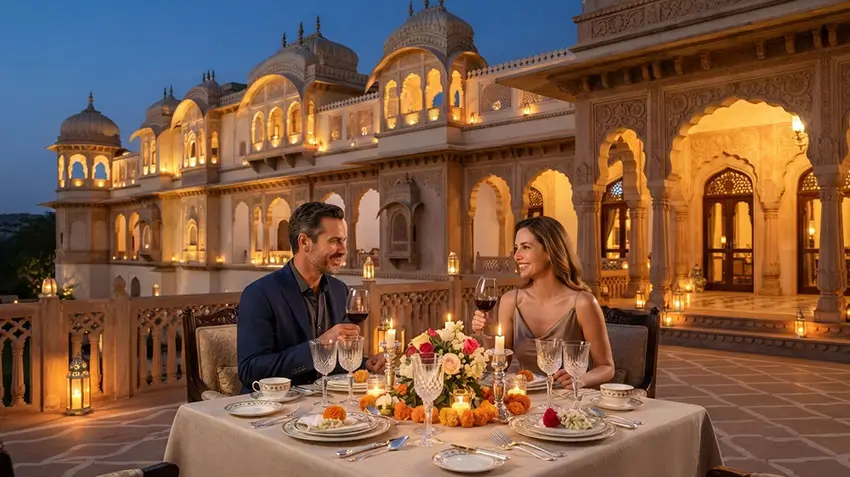
Meals on board are a central part of the experience. The train has formal dining cars where breakfast, lunch and dinner are served, with a mix of Indian and international dishes. Some meals may be taken off the train at special venues during excursions. Dining is often one of the highlights of the journey.
Beverages are included according to the published policy. Check which drinks are covered and whether any premium selections carry an extra charge, so you know what to expect in the bar and at meals.
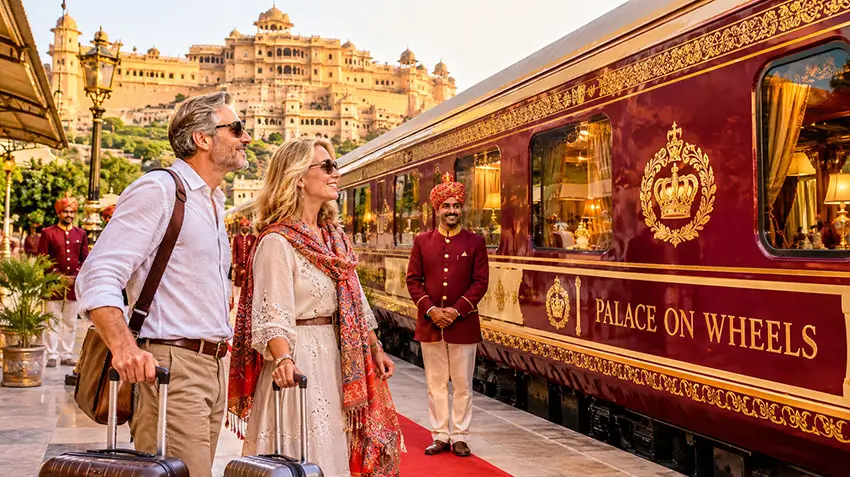
Off-train excursions are where the fare delivers much of its value. At each stop, guests visit forts, palaces, temples and other sights with guides, often with special arrangements such as private access, cultural performances or unique experiences not easily arranged independently. On a private tour, each of these would require separate guides, tickets and transport.
Higher cabins can change the excursion experience. In some categories, private cars or dedicated guides may be provided, giving you more flexibility and a quieter experience at each stop. Ask which excursion benefits apply to your chosen cabin.
Onboard service is another significant inclusion. Staff look after your cabin, dining and daily needs, and in the higher categories personal butler service adds an extra layer of attention.
Some costs are not included. Flights to India, hotels before and after the journey, travel insurance, gratuities, personal purchases and any optional activities outside the itinerary are usually extra. Add these to your budget so you see the full cost of the trip.
When you add up everything the fare covers, the Maharajas' Express can look quite different from the headline price. For many travellers, the convenience of having every meal, drink, guide and ticket arranged is part of what makes the journey special.
Special experiences on the excursions can be a highlight in themselves. Depending on the journey, these may include events such as a private dinner at a fort or palace, a cultural performance arranged for guests, a wildlife safari or a visit timed for the best light at a famous monument. Arranging comparable experiences independently would require significant planning and cost, which is part of why the fare can represent good value for travellers who would want these experiences anyway.
It is still important to read the itinerary for your chosen journey carefully. Not every departure includes the same experiences, and some activities may be optional or seasonal. Knowing exactly what is planned helps you judge whether the fare matches your interests.
Gratuities are one cost that travellers often overlook. Onboard staff, guides and drivers on excursions work hard to make the journey smooth, and tipping is customary. Ask your tour operator for guidance on sensible amounts, and add them to your budget so the final days of the journey are not spent worrying about cash.
Solo travellers should look carefully at single-occupancy rules. The published fares are generally quoted per person on a sharing basis, and single occupancy usually carries a supplement. Ask for the single-occupancy fare for your chosen cabin and journey so you can budget accurately.
GST is added to the fare at 5 percent. On a large booking, this adds a noticeable amount. For a couple paying $17,600 for a Deluxe Cabin on a long journey, GST adds about $880, bringing the total to around $18,480. For a couple in a Suite paying $31,200, GST adds about $1,560.
Always ask for quotes that show the fare, the tax and the total separately. This makes comparison easier and avoids surprises when the invoice arrives.
Currency is another factor. Fares are quoted in US dollars, and paying in another currency means exchange rates and bank charges will affect the final cost. Ask how payment is taken and whether any fees apply.
Families should check the rules for children and extra beds. Train cabins have limited space, and not every category can accommodate an extra guest. Ask early if you are travelling with children.
The payment schedule should also be understood. The train publishes a reservation procedure that allows booking with an advance payment, with the balance due before departure. Read the cancellation terms carefully, since charges can rise as the departure approaches.
Given the sums involved, a solid travel insurance policy is well worth having. Choose a policy that covers cancellation, medical emergencies and travel disruption, and buy it soon after paying the advance.
With single-occupancy rules, tax, currency and payment terms included, you have a complete picture of the cost. This is the figure to compare with other ways of seeing India.
A worked example helps. Take a couple choosing a Junior Suite on a long journey at around $11,000 per person. The fare for two is about $22,000, and GST at 5 percent adds around $1,100, bringing the total to roughly $23,100. Add two nights at a Delhi hotel before the train, flights, insurance and gratuities, and you have the full holiday figure. Doing the same for the Deluxe and Suite shows exactly what each upgrade adds to the complete trip.
Planning a luxury train holiday in India? Get expert assistance with Maharajas' Express ticket prices, cabin fares, available departures and travel inclusions. Whether you prefer a Deluxe Cabin, Junior Suite, Suite or Presidential Suite, we can help you choose the right experience for your budget and travel plans.
Many travellers weigh the Maharajas' Express against a private tour of Rajasthan and northern India. The comparison is useful, but it needs to be made on the total experience rather than the price of a room.
A luxury private itinerary covering similar destinations would include palace hotels, private cars and drivers, private guides, meals, entrance tickets and internal transfers. Each of these has its own cost, and together they can add up to a figure close to or even above the train fare, depending on the hotels and service level you choose.
The train offers things a private tour cannot easily match. You travel between destinations overnight, waking up in a new city without long road journeys. The onboard atmosphere, with formal dining, a bar and lounge cars, creates a social experience that many guests love. The special arrangements at some destinations add moments that are hard to organise independently.
A private tour offers other advantages. You can choose your own hotels, set your own pace, stay longer where you like and change plans as you go. You avoid fixed schedules and group timings. You can include destinations the train does not visit.
Your travel style decides which suits you. Guests who enjoy structure, sociability and the romance of rail often prefer the train. Guests who value flexibility, privacy and independence often prefer a private itinerary. Some combine both, taking a shorter train journey and adding a private tour before or after.
Luxury Private Tours Of India can price both options side by side. We check train availability for your dates, calculate the full cost with tax and compare it with a private itinerary covering similar ground, including hotels, guides and transport. This lets you choose between two complete holidays rather than two headline prices.
Timing your booking also affects cost in practical ways. Booking early gives you the widest choice of cabins and departures, and you can plan flights and hotels at leisure. Booking late may leave only certain cabins available, which can push you into a higher category than you intended or a departure that suits you less well. For most travellers, deciding on the journey and cabin several months ahead gives the best balance of choice and flexibility.
Finally, remember that the fare is only one part of the value. The memories of waking up in a new city, dining in a beautifully decorated carriage and exploring India's great sights with everything arranged for you are what most guests remember. The numbers help you choose wisely, but the experience is what you are really buying.
Health and pace are worth a thought before you commit. The journeys involve early starts, full days of sightseeing and overnight travel, which suits most travellers but can tire some. Guests with limited mobility should ask how boarding, excursions and moving between carriages are handled. Knowing what each day involves helps you decide whether a long journey, a short one or a higher cabin with more personal service is the best fit.
For the longer journeys, published fares are roughly $8,400 to $8,800 per person in Deluxe, $10,700 to $11,200 in Junior Suite, around $15,600 in Suite and up to about $26,800 in the Presidential Suite.
No. GST at 5 percent is added to the fare.
Accommodation, meals, a range of beverages and guided off-train excursions, according to the published product.
The published figures are generally per person on a sharing basis. Confirm the basis for your cabin.
Yes. Treasures of India covers three nights and focuses on the Golden Triangle.
Single occupancy usually carries a supplement. Ask for the single fare for your chosen cabin.
A range of beverages is included. Check whether premium selections carry extra charges.
Some categories may include private cars or dedicated guides. Ask which benefits apply to your cabin.
Not always. Compare the full cost of each, including hotels, meals, guides, transport and tickets.
Flights, pre- and post-train hotels, insurance, gratuities and personal purchases are usually extra.