
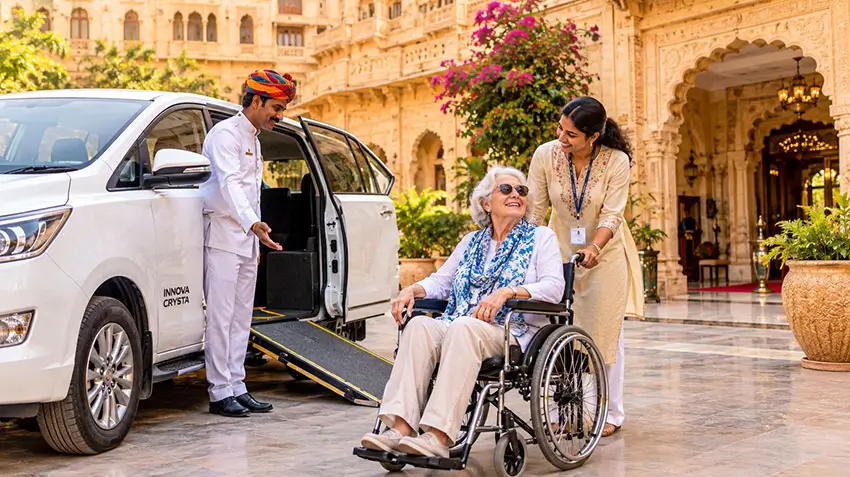
For a wheelchair user, the word accessible on its own tells you almost nothing. One hotel uses it for a room with a wider door. Another uses it for a room with a roll-in shower, grab rails and a lowered bed. A monument may call itself accessible because there is a ramp at the entrance, even though the main courtyard sits up a flight of stone steps. A good trip is built from specific facts, not reassuring labels.
A wheelchair accessible India tour can be deeply rewarding. India's palaces, forts, gardens and rivers are among the most beautiful in the world, and many of them can be enjoyed from a wheelchair with the right planning. Luxury travel, in this context, is less about gold taps and grand suites and more about removing friction: the right vehicle, the right bathroom, the right route through each site and a pace that leaves energy for enjoyment.
This guide explains how to plan such a trip step by step. We start with the traveller and the chair, then look at vehicles, hotels and monuments, and finally at pacing, which is often the single biggest factor in whether an accessible trip feels relaxed or exhausting.
Dignity is worth naming as a goal. A well-planned accessible trip avoids moments where the traveller has to be carried up steps in public, waits while staff search for a ramp or is left behind while others explore. These situations are not only uncomfortable. They can take the joy out of a day. Planning ahead so that every entrance, vehicle and room works as expected is what separates an accessible luxury tour from an ordinary trip with a wheelchair added.
Every accessible itinerary should begin with the person, not the destination. Before any hotel is confirmed or any car is booked, the planner needs a clear picture of the traveller's needs. This information shapes every other decision on the trip.
The first details are about the chair. What is its width and length? How much does it weigh? Does it fold, and if so, how small does it become? Is it manual or powered, and if powered, what type of battery does it use? These facts decide whether the chair fits through doors, into lifts and into vehicles, and whether it can travel by air without problems.
The second set of details concerns transfers. Can the traveller move independently from the chair to a car seat, a bed or a toilet? Do they need one person to help, or two? Is a hoist required? How many steps can they manage, if any, with support? These answers decide which vehicles, rooms and routes are workable.
The third area is bathroom needs. Some travellers need a roll-in shower with a seat. Others can use a bath with grab rails. Toilet height, the space beside the toilet for a side transfer and the position of grab rails can all matter. These details should be gathered early, because they are often the hardest thing to find in heritage hotels.
Medical and equipment needs should also be shared. Oxygen, a portable hoist, a special cushion, a shower chair or other equipment may affect vehicle space and hotel arrangements. Travellers who need a companion or caregiver should say so, so accommodation can be arranged close together.
Energy levels deserve an honest conversation. How many hours of activity can the traveller comfortably manage in a day? Do they need rest in the afternoon? How do heat and long drives affect them? These answers shape the pace of the whole trip.
It also helps to know past experiences. What has worked well on previous trips, and what has caused problems? Travellers often know exactly which small details make a difference, and sharing them helps the planner avoid repeating old mistakes.
With this information in hand, the planner can check each hotel, vehicle and site against real needs rather than general promises. It is the foundation of a successful trip.
Climate should be part of the planning conversation too. Heat can be a serious issue for some wheelchair users, especially those with conditions that affect temperature regulation. The cooler months from October to March are usually the most comfortable for travel across northern India. If travel must happen in the hotter months, plan sightseeing for early mornings and late afternoons, and make sure vehicles and rooms have reliable air conditioning.
Enjoy a stress-free India holiday with accessible transportation, wheelchair-friendly hotels and professional tour guides. Contact us to arrange a personalised luxury India tour designed around your comfort and accessibility needs.
In India, most sightseeing happens by road, and the vehicle is often the decisive factor in how comfortable the trip feels. A luxurious SUV may look like the obvious choice for a high-end tour, but its seat height can make transfers difficult or unsafe. The right vehicle is the one that suits the traveller's transfer method and chair, not the one with the most prestigious badge.
For travellers who can transfer with a little help, a car with a moderate seat height may work best. Too high, and lifting becomes hard. Too low, and getting up again becomes difficult. Ask for the seat height and door opening dimensions, and if needs are significant, ask for photographs.
For travellers who stay in their chair, a van with a ramp or lift is needed. These are less common in India than in some countries, so they should be booked early and confirmed carefully. Ask how the chair will be secured, where the traveller will sit relative to windows and air conditioning, and whether the vehicle has seat belts suitable for a wheelchair user.
Luggage and equipment must fit alongside the chair. On long road journeys between cities, a vehicle that is technically large enough may feel cramped once suitcases, a folded chair and equipment are loaded. Ask the operator to plan space for everything.
The driver's role matters too. A good driver will help with the chair, know where accessible stops are along the route and drive smoothly to reduce discomfort on rough roads. Ask whether the driver has experience with wheelchair users.
Long drives between cities can be tiring. Roads such as Delhi to Agra or Jaipur to Udaipur involve several hours in the vehicle. Plan regular breaks at places with accessible toilets, such as good hotels or highway restaurants the driver knows well. Accessible public toilets are not common, so these stops should be planned in advance.
A backup plan is important. If the vehicle breaks down on a long route, what happens? A professional operator should have a plan for a replacement vehicle that also meets the traveller's needs.
Airport transfers deserve special attention. Airline wheelchair assistance and airport services should be requested separately with the airline, and the ground transfer should be timed to meet the traveller at the right point. Coordination between the airline, the airport and the driver avoids long waits and confusion.
Flights within India need their own planning. Domestic airlines can usually provide wheelchair assistance and aisle chairs, but these must be requested in advance with the airline. Some smaller airports use steps rather than aerobridges, which may require a lift or special boarding arrangement. Ask about the boarding method at each airport on your route, and allow extra time at check-in and security.
Powered wheelchairs and scooters need special attention on flights. Airlines have rules about battery types and sizes, and documentation may be needed. Contact each airline well before travel to confirm what is allowed and how the chair will be handled.
India's heritage hotels are among its greatest attractions, but they were built long before accessibility was considered. Palaces often have steps, uneven floors, narrow doors and bathrooms that are hard to adapt. Newer five-star hotels usually offer easier access, but even these vary in their facilities.
For each hotel, check the full route from the car to the room. Is there step-free access from the drop-off point to the lobby? Are there lifts, and are they large enough for the chair? How wide are the doors to the room and bathroom? Are there thresholds or steps within the room?
The bathroom is often the most important detail. Ask whether the shower is roll-in, whether there is a shower seat, how high the toilet is, where the grab rails are and how much space there is beside the toilet. Photographs and measurements are more reliable than descriptions.
Bed height matters for transfers. Ask for the height of the bed, and whether it can be adjusted if needed. Some hotels can provide a different bed or add a platform to change the height.
Dining and public areas should also be checked. Can the traveller reach the restaurant, pool area and gardens without steps? If a palace hotel has beautiful terraces up a flight of stairs, is there an alternative route or viewpoint?
Monuments present their own challenges. Sites such as the Taj Mahal have made efforts to improve access, including ramps and routes suitable for wheelchairs in parts of the complex. Others, such as hilltop forts with steep paths and stone steps, may be only partly accessible. For each site, ask the guide for a specific route and a realistic description of what can be seen.
Where full access is not possible, alternatives can still offer a rewarding experience. A viewpoint across the river, a garden with a clear line to the monument, a museum at ground level or a vehicle route through an area can all bring the site closer. A good guide will know these options.
Heritage hotels can still be part of an accessible trip. Some offer ground-floor rooms, adapted bathrooms or routes that avoid steps. Others may be beautiful but unsuitable. The key is to check each property individually and choose the ones that combine character with practical access.
Equipment backup is a sensible part of any plan. A puncture repair kit, spare inner tubes, charger adapters for Indian sockets and any small spare parts your chair uses can save a great deal of trouble. In larger cities, it may be possible to find repair services, but this takes time. Carrying the basics, and telling your operator what the chair needs, means small problems stay small.
Explore India's beautiful destinations with confidence and comfort. From wheelchair-accessible cars to suitable hotels and experienced guides, we help organise every detail of your accessible luxury journey.
Many travellers try to see as much of India as possible in a short time, with one-night stops and long drives between cities. For wheelchair users, this pace can be exhausting. Each hotel change means packing, loading the vehicle, a long drive, unloading and settling into a new room. These transfers consume energy that could be spent enjoying the trip.
A slower itinerary, with fewer destinations and longer stays, is often better for everyone. Staying two or three nights in each place reduces the number of transfers, allows rest between activities and gives time to enjoy the hotel as well as the sights. It turns the trip from a race into a holiday.
Daily schedules should also be gentle. A morning visit to a monument, a rest in the afternoon and a relaxed dinner in the evening often work better than packing several sites into one day. Heat can be tiring, especially from April to June, so early morning and late afternoon visits are usually best.
Rest days are valuable. A day with no sightseeing, spent at a beautiful hotel, gives time to recover and enjoy the setting. Many travellers find these days among the most memorable of the trip.
Trained guides make a real difference. A guide who understands accessibility can plan routes, find the best viewpoints, handle the chair on uneven ground and adjust the day as needed. Ask whether guides have experience working with wheelchair users.
Companions and family members benefit from a slower pace too. Travelling with a wheelchair user often involves physical effort, and a relaxed schedule helps everyone stay fresh and enjoy the trip together.
Luxury Private Tours Of India plans accessible journeys around real measurements and verified details. We gather information about the traveller and the chair, check vehicles and hotels individually, plan routes through monuments with experienced guides and build a pace that leaves room for rest. The aim is a trip that feels comfortable, dignified and really enjoyable, with honest information about what each place can offer.
Emergency planning gives peace of mind. Ask your operator to note the nearest good hospital in each city, carry a summary of relevant medical information and make sure travel insurance covers pre-existing conditions and equipment. Most trips never need any of this, but knowing it is in place allows everyone to relax.
Many travellers find that India surprises them. Staff at good hotels are often eager to help, guides go out of their way to find a better route, and drivers quickly learn how to handle the chair with care. With accurate information and careful planning, a wheelchair user can enjoy the Taj Mahal at sunrise, a palace dinner in Udaipur and a boat on the Ganges in Varanasi. Honest preparation is what makes those moments possible.
The chair's size and weight, whether it folds, transfer ability, assistance needs, bathroom requirements and any medical equipment.
No. Check the full route from the car to the room, plus the bathroom, lifts, doors, dining areas and emergency procedures.
Sometimes, but high seats can make transfers hard. Choose the vehicle by transfer method, not brand.
Not always. Some have good access, while others have steps and uneven paths. Ask for site-specific routes and alternatives.
Many travellers prefer their own chair. Discuss spare parts, batteries and vehicle space before travel.
Usually yes. Request adjacent or connecting rooms early, since accessible rooms are limited.
Fewer hotel changes, longer stays, rest periods and realistic transfer times usually improve the trip for everyone.
No. The guide and driver should know reliable stops at hotels and restaurants along the route.
Yes. Request airline and airport wheelchair services separately and coordinate them with your ground transfer.
Verified details, trained assistance, suitable vehicles and honest alternatives, rather than broad promises.