Every traveller to Rajasthan sees the forts. Every traveller sees the palaces. They rise above the cities, impossible to miss, and they deserve every photograph taken of them. But Rajasthan keeps some of its most extraordinary architecture in the one place most tourists never think to look: beneath the ground.
The stepwells of Rajasthan are among the most remarkable and least appreciated architectural achievements in India. Descending storey after storey into the earth, lined with geometric flights of steps that fold and multiply in mesmerising patterns, these structures are at once feats of engineering, works of sculptural art, and quiet, atmospheric spaces unlike anything above ground. They are the hidden architecture of Rajasthan, and the travellers who seek them out are rewarded with some of the most striking and memorable sights the region offers.
This guide explores the stepwells of Rajasthan: what they are, why they exist, why they are so visually extraordinary, where the finest examples can be found, and how a thoughtfully planned journey can weave these hidden wonders into a luxury Rajasthan experience.
To appreciate the stepwells of Rajasthan, it helps first to understand what they actually are.
A stepwell, known in this region as a baori or bawdi, is a well that is reached not by lowering a bucket from the top, but by descending a series of steps to the water itself. Rather than a simple shaft, a stepwell is an elaborate, multi-storey structure cut down into the earth, with flights of steps leading from ground level all the way down to the water far below.
The genius of the design lies in its response to a specific problem. Rajasthan is a largely arid region, where water has always been precious and the level of groundwater rises and falls dramatically with the seasons. A stepwell solved this. Because the steps descend continuously to the water, the well remained usable whatever the water level, in the dry season the steps led further down, in the wet season less far. It was a brilliant, practical answer to the challenge of water in a desert land.
But the stepwells of Rajasthan are far more than practical structures, and that is what makes them extraordinary.
Beyond Forts and Palaces Lies Rajasthan's Greatest Secret
Discover breathtaking stepwells carved deep into history, revealing a side of Rajasthan that few travelers ever experience.
Stepwells served their communities in ways that went well beyond simply providing water.
They were, first, vital water sources, the lifeline of settlements in a dry land. But they were also cool, shaded retreats. Descending into a stepwell, away from the fierce surface heat, a visitor finds the air noticeably cooler, and stepwells became places of rest and respite, especially in the heat of the day.
They were social and community spaces, where people gathered, met and spent time, particularly the women whose daily task of fetching water brought them together at the well. Many stepwells also held religious and ceremonial significance, with shrines, niches and sacred associations woven into their structure, making them spiritual as well as practical places. Some were built as acts of patronage and charity, commissioned by rulers and wealthy individuals as public works for the benefit of the community.
A stepwell, then, was a piece of civic infrastructure, a cool refuge, a social hub and a sacred space, all in one descending structure. Understanding this many-layered purpose makes a visit far richer.
Even knowing their purpose, nothing quite prepares a traveller for the visual impact of a great Rajasthan stepwell.
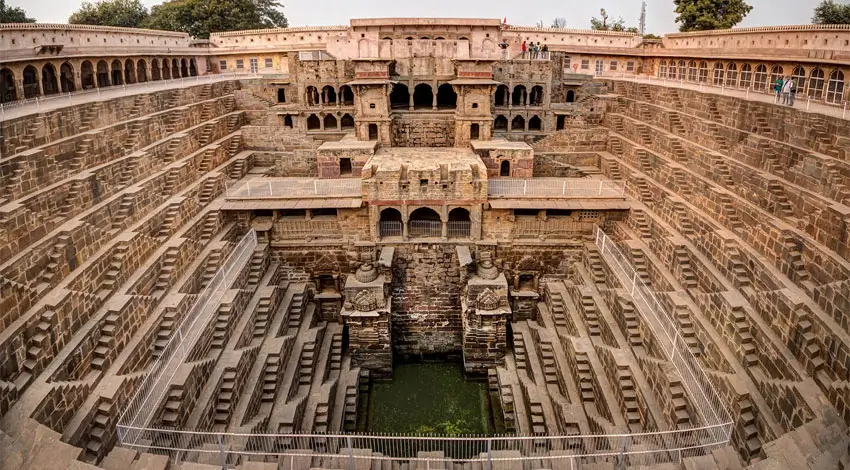
The defining feature is the steps themselves. In the finest stepwells, steps line the walls in intricate, repeating geometric patterns, descending in interlocking flights that crisscross and multiply as they go down. The effect is almost hypnotic, a play of light, shadow, line and symmetry that the eye follows down and down. There is a reason stepwells have become so beloved by photographers and architects: they are, quite simply, mesmerising to look at.
Beyond the steps, many stepwells feature genuine architectural and sculptural refinement: carved pillars, ornamented galleries, pavilions, niches, balconies and decorative detail, often of real artistry. The grandest stepwells are not merely functional pits but designed, considered, beautiful structures.
And then there is the experience of being inside one. Descending into a stepwell is a unique sensation: the temperature drops, the surface world recedes, sound changes, and a visitor enters a quiet, contained, atmospheric space that feels apart from everything above. It is this combination of striking visual pattern, sculptural beauty and immersive atmosphere that makes the stepwells of Rajasthan so unforgettable.
Rajasthan holds a number of remarkable stepwells, scattered across the state, some celebrated and some little-visited.
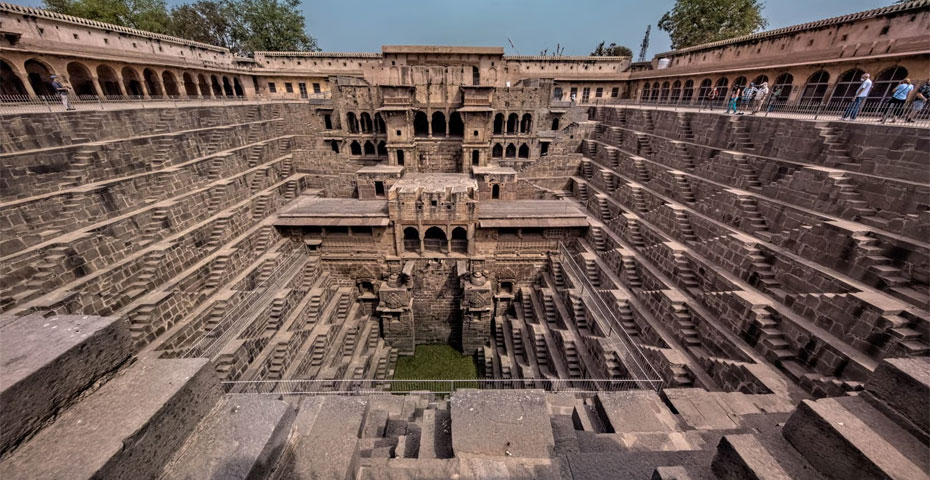
The most famous stepwell in Rajasthan, and one of the most spectacular in all of India, is Chand Baori, located in the village of Abhaneri. Chand Baori is an extraordinary sight: a vast, deep stepwell whose walls are lined with a breathtaking arrangement of steps descending many storeys down, in a precise, geometric pattern that is genuinely awe-inspiring to behold. It is one of the largest and most visually dramatic stepwells anywhere, and it has rightly become an iconic image of India's stepwell architecture. Conveniently, Abhaneri lies in the region between Jaipur and Agra, which makes Chand Baori a superb addition to a journey along that route.
The area in and around Jaipur holds beautiful stepwells, including elegant, atmospheric examples that have been restored and are a pleasure to visit. Some of these have become quietly celebrated for their geometric beauty, offering striking architecture within easy reach of the city.
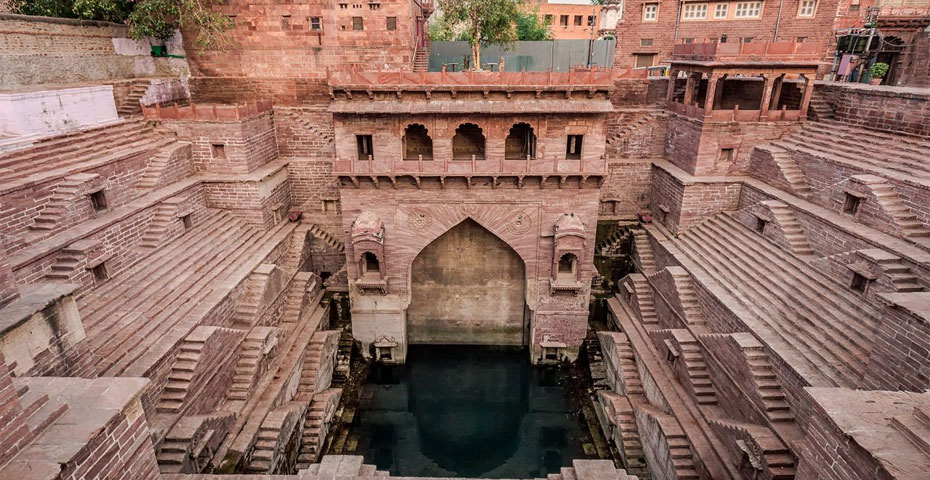
Jodhpur's old city holds a beautifully restored stepwell, a striking example of the form set within the historic Blue City, as noted in our dedicated Jodhpur guide. Other Rajasthan cities and towns hold their own stepwells, some restored and accessible, others more weathered and atmospheric, woven into the historic fabric of the region.
The town of Bundi is particularly associated with stepwells, holding a number of historic examples and known for its baori heritage. For a traveller with a genuine interest in stepwell architecture, Bundi rewards exploration.
A private operator can identify which stepwells best suit a given itinerary and interest, including both the celebrated examples and the lesser-known, atmospheric ones that most tourists never reach.
The wonderful thing about stepwells is how naturally they enrich an existing Rajasthan itinerary.
Many stepwells lie conveniently close to the destinations and routes a Rajasthan journey already follows. Chand Baori, as noted, sits on the route between Jaipur and Agra, turning a transfer into an experience. Stepwells in and around Jaipur, Jodhpur and other cities can be visited as part of time already spent in those places. A stepwell visit need not be a major detour. More often, it is a remarkable addition slotted neatly into the journey.
What stepwells contribute is something distinctive. Amid the forts and palaces, a stepwell offers a completely different kind of space, hidden rather than towering, geometric rather than grand, cool and quiet rather than imposing. They add depth and variety to a journey, and they take a traveller a satisfying step beyond the standard route. For photographers especially, as our photography guide explores, they are among the most rewarding subjects in all of Rajasthan.
A few points help a traveller make the most of a stepwell visit.
A guide adds enormous value, explaining the history, the purpose, the engineering and the stories of a stepwell, so that a visit becomes an understanding rather than simply a look. The architecture is remarkable, but the layers of meaning behind it are what make it resonate.
Timing matters. The light changes the way a stepwell looks dramatically, and certain times of day show the geometry and shadow to their best effect. The cool winter season is the most comfortable time to visit, as it is for Rajasthan generally.
Visitors should treat stepwells with care and respect, as historic, sometimes sacred structures. Where stepwells have shrines or religious associations, the appropriate respect applies. And where access into the deeper levels is restricted, for conservation or safety, these restrictions should be honoured; the beauty of a stepwell is fully appreciated from the accessible viewpoints regardless.
Descend Into Rajasthan's Hidden Architectural Wonders
Explore Rajasthan's magnificent stepwells with a privately curated journey, where timeless architecture, royal history, and hidden treasures come together beyond the usual tourist trail.
Stepwells are, almost by definition, the things travellers miss. They are not on every standard itinerary, some are little-known, and their significance is not obvious without explanation. This is precisely why a private, tailored journey is the ideal way to experience them.
A private operator knows the stepwells, the celebrated ones and the hidden gems, and can identify which best suit your route and interests. It weaves them into your itinerary intelligently, slotting them in where they enrich the journey without disrupting it, turning a transfer or a free afternoon into a discovery. It provides a knowledgeable guide who brings the history, engineering and meaning of these structures genuinely to life. It provides the private transport and flexibility to reach stepwells, including the off-the-beaten-path examples, at the right time and in comfort. And it ensures these hidden wonders take their place within a wider luxury Rajasthan journey, adding depth, variety and a real sense of discovery.
The result is a Rajasthan journey that goes beyond the obvious, that includes the architecture beneath the surface as well as the forts and palaces above it, and that gives a traveller the quiet satisfaction of having seen what most tourists walk straight past.
The forts and palaces of Rajasthan are unforgettable, and rightly celebrated. But the stepwells of Rajasthan offer something the great monuments cannot: the thrill of discovery, the beauty of hidden geometry, the cool quiet of a space carved deep into the earth, and the satisfaction of seeing a side of the region most travellers never do. For the curious traveller who wants Rajasthan in its full depth, these hidden architectural wonders are not to be missed. Look beneath the surface, and Rajasthan rewards you with some of its most extraordinary sights.
If you would like to experience the hidden architecture of Rajasthan, let us design a private, tailored journey for you that includes its remarkable stepwells alongside its famous forts and palaces. We identify the finest stepwells for your route, weave them seamlessly into your itinerary, and provide expert guiding to bring them to life. Get in touch to begin planning a luxury Rajasthan journey that goes beyond the obvious.
A private operator identifies the finest stepwells for your route, weaves them intelligently into your itinerary, provides expert guiding, and supplies the transport and flexibility to reach even the hidden examples.
Access varies. Some stepwells allow descent, while others restrict access to deeper levels for conservation or safety. Their beauty is fully appreciated from the accessible viewpoints regardless.
Very much so. The geometric patterns, light, shadow and atmosphere make the stepwells of Rajasthan among the most rewarding photographic subjects in the region.
The cool winter season is the most comfortable time. Within a day, certain times show the geometry and shadow of a stepwell to their best effect.
Yes. A guide explains the history, purpose, engineering and stories of a stepwell, turning a visit into a genuine understanding rather than simply a look.
Stepwells are not on every standard itinerary, some are little-known, and their significance is not obvious without explanation, so many travellers walk past them unaware.
No. Many stepwells lie close to the destinations and routes a Rajasthan journey already follows, so they can be slotted in neatly rather than requiring a major detour.
The town of Bundi is particularly associated with stepwells, holding a number of historic examples, and rewards travellers with a genuine interest in baori architecture.
Yes. Jodhpur's old city includes a beautifully restored stepwell, a striking example of the form set within the historic Blue City.
Yes. The area in and around Jaipur holds beautiful, atmospheric stepwells, including restored examples celebrated for their geometric beauty, within easy reach of the city.
Chand Baori is in Abhaneri, in the region between Jaipur and Agra, which makes it a convenient and rewarding addition to a journey along that route.
Chand Baori, in the village of Abhaneri, is the most famous stepwell in Rajasthan and one of the most spectacular in India, a vast, deep structure with breathtaking geometric flights of steps.
The finest stepwells feature intricate, repeating geometric patterns of steps descending many storeys, creating a mesmerising play of line, light and shadow, often with carved pillars and sculptural detail.
Stepwells also served as cool, shaded retreats from the heat, as social and community gathering places, and many held religious and ceremonial significance, with shrines and sacred associations.
Rajasthan is a largely arid region where water is precious and groundwater levels vary greatly with the seasons. Stepwells provided reliable access to water whatever the water level, in a desert land.
A stepwell, known in Rajasthan as a baori, is a well reached by descending a series of steps to the water itself, rather than drawing water from the top. It is an elaborate, multi-storey structure cut into the earth.