Modern travel runs on connectivity. Maps, messaging, restaurant bookings, ride apps, photo sharing and a quick call back home all depend on a working mobile signal. For a visitor to India, getting that signal sorted in the first day or two makes everything that follows smoother.
The good news is that India has some of the most affordable and fastest mobile data in the world. The process of getting a SIM card for tourists in India is straightforward once you know the steps, the documents and the choices involved. This guide walks through all of it in plain terms, so you can land, get connected, and spend your attention on the journey rather than on paperwork.
It is written for the traveller who wants reliability and ease. If you are travelling on a private tour, your operator can often handle a great deal of this for you, and we cover that option too.
The first question many travellers ask is whether they need a local connection at all. International roaming from your home carrier will work in India, but it is expensive, often dramatically so. A few days of roaming can cost more than two weeks of generous local data.
A local connection solves three things at once. It gives you reliable coverage across India's cities, highways and rural areas, where a foreign carrier's roaming partner may be patchy. It gives you data at a fraction of roaming prices. And it gives you a working Indian number, which is useful for ride apps, restaurant confirmations and any local booking that sends a verification code by text.
For most visitors, a prepaid SIM India package or an eSIM for India is the sensible choice. Which of the two suits you depends on your phone and your preferences, and the next sections explain both.
Beyond Connectivity, Discover True Convenience
While staying connected is important, having every aspect of your journey expertly planned makes all the difference.
India has a small number of major mobile networks, and understanding them helps you choose well.
Reliance Jio is one of India's largest networks and is known for fast data and strong 4G and 5G availability. It has extensive coverage across both urban and rural areas and consistently ranks well for mobile internet speed. Jio is a budget-friendly and reliable choice for travellers, and it supports eSIM.
Airtel is another of India's leading operators, with a strong reputation for overall network quality, particularly on highways and in rural areas. Many seasoned travellers prefer Airtel for the consistency of its coverage when moving between regions and states. Airtel offers wide 4G coverage, expanding 5G, and competitive prepaid plans.
Vi is the third major private operator. Its coverage is good in cities but can be less consistent in remote areas compared with Jio and Airtel. For travellers staying mainly in major destinations it is a workable option.
BSNL is a state-owned operator. It has coverage in some areas that the private networks reach less well, but its overall service quality and speed tend to lag behind. For most tourists it is not the first recommendation.
For a traveller covering several regions of India, Airtel and Jio are the two strongest choices. Airtel is often favoured for cross-country consistency, and Jio for data speed and value.
There are two ways to get a local connection, and the right one depends mainly on your phone.
A physical SIM card is the traditional small chip that slots into your phone. It works with virtually every handset, it is sold widely, and staff at carrier stores can help with setup and activation. The trade-off is that you need to visit a store or kiosk, present documents, and wait for activation, which can take a few hours.
An eSIM for India is a digital SIM built into newer phones, with no physical chip to insert. You activate it by scanning a code or completing a short online process. The appeal is convenience: an eSIM can be arranged before you travel or shortly after you arrive, often without hunting for a store. The catch is that eSIM availability for tourists in India can be limited and conditions vary by carrier, so it is worth confirming that your specific phone model and chosen plan support tourist eSIM activation before relying on it.
A practical approach for many travellers: if your phone supports eSIM and you want to land already connected, arrange a travel eSIM in advance. If you prefer the certainty of a local carrier's full service and a proper Indian number, plan to buy a physical SIM on arrival.
To buy a SIM card for tourists in India, you must complete a short identity verification. This is a legal requirement, and it applies to all carriers. Be ready with the following.
Your passport, which is the primary identity proof for foreign visitors. A passport-sized photograph, as some stores ask for one, though many can take a photo on the spot. Your Indian visa or entry details. A local address, which is almost always your hotel; carrying a copy of your hotel booking confirmation is genuinely helpful here. In some cases a local reference number, which your hotel can often provide.
The verification is routine, and carrier staff handle it many times a day. Carrying a printed hotel booking and your passport will make the process quick.
There are several places to buy a prepaid SIM India package, each with its own advantages.
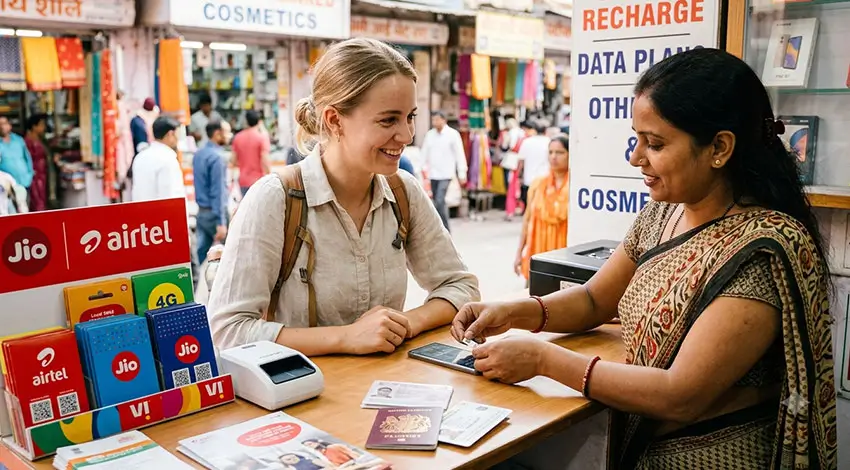
Major international airports such as Delhi, Mumbai and Bengaluru have SIM card counters and kiosks aimed specifically at arriving tourists. This is the most convenient option for getting connected immediately on landing. Airport prices can be slightly higher than in the city, but the convenience is significant, especially after a long flight.
Branded stores for Airtel, Jio and Vi are found across Indian cities. Buying from an official store is the most reliable route, as staff are equipped to handle foreign tourist applications correctly and complete activation properly. We recommend official stores over small third-party shops, which may not be set up to process foreign documentation.
Travel eSIM providers allow you to arrange a digital connection online before or shortly after arrival. This suits travellers with compatible phones who want to skip the store visit entirely.
A note on price: a tourist prepaid package in India is remarkably inexpensive. A typical plan with a generous daily data allowance and calls, valid for around four weeks, often costs the equivalent of well under ten US dollars including the SIM itself. The SIM card is usually free, with payment going towards the recharge plan.
Here is the simple sequence for arranging a connection once you reach India.
First, on landing, decide between the airport counter and a city store. If you want connectivity immediately, use the airport counter. If you are being met by a private driver and heading straight to your hotel, you can buy a SIM in the city the next day.
Second, present your documents: passport, visa details, a photograph if required, and your hotel booking as address proof.
Third, choose a plan. For most travellers a plan with one to two gigabytes of data per day, unlimited calls and around twenty-eight days of validity is more than enough.
Fourth, pay for the recharge. The amount is small, and the SIM itself is typically free.
Fifth, wait for activation. This can take anywhere from a few minutes to a few hours. Staff will usually tell you when to expect the connection to go live.
Sixth, once active, test it. Make a short call and load a webpage to confirm both calls and data are working before you leave the store or area.
Your Perfect India Journey Starts Here
Explore India's iconic landmarks, hidden gems, and authentic cultural experiences with a personalized itinerary created just for you.
India is a large country, and a SIM bought in one state will generally work across the others under national roaming. For most current tourist prepaid plans, national usage is included, but if you are travelling widely it is worth confirming with the carrier at the point of purchase that your plan covers calls and data nationwide without extra charges. Mentioning your full itinerary to the staff helps them recommend the right plan.
A local SIM is the backbone of your connectivity, but a few other options are worth knowing.
Hotel and restaurant wifi is widely available across India, and luxury hotels in particular offer reliable, fast connections in rooms and public areas. For a traveller on a comfortable itinerary, hotel wifi handles a great deal of routine browsing.
Pocket wifi devices, which create a personal wifi hotspot, are available from some carriers and rental services. They suit groups or families who want several devices online through one connection.
Your phone's own hotspot feature, paired with a generous local data plan, can share that connection with a tablet or laptop, which is often simpler than carrying a separate device.
If you are travelling India on a private, tailored tour, connectivity is one more thing that can be arranged for you rather than by you. A good operator can advise on the best carrier for your specific itinerary, can have a SIM ready or assist with activation on arrival, and ensures your hotels all offer dependable wifi.
More importantly, on a private tour you are rarely dependent on your own phone for the essentials. Your driver and guide handle navigation, your hotels and experiences are pre-booked, and your operator is reachable to resolve anything that arises. Connectivity becomes a convenience for sharing photos and staying in touch with home, rather than a lifeline you must manage carefully. For many travellers, that shift is one of the quiet pleasures of travelling with everything arranged.
A few final pointers will keep things smooth. Buy your SIM early in the trip rather than leaving it for later, so you have the most days of use. Keep your passport and hotel booking handy for the verification. Note down your new Indian number, as you will need it for app verifications. Download offline maps of your destinations as a backup for areas with weaker signal. Keep your home SIM safe if you remove a physical SIM, ideally in the little tray tool case or a labelled pouch. And confirm your plan's validity date so a recharge does not lapse mid-trip.
With a local connection sorted in the first day or two, the rest of your India journey runs on fast, inexpensive, reliable data, and your focus stays where it should be: on the country in front of you.
Yes, eSIMs are available, but tourist eSIM options can be limited and conditions vary by carrier. Confirm that your specific phone model and chosen plan support tourist eSIM activation before relying on it.
You need your passport, your visa or entry details, a local address such as your hotel booking, and sometimes a passport photograph. A printed hotel confirmation makes the process quicker.
SIM cards are sold at airport counters in major cities, at official Airtel, Jio and Vi stores, and online as travel eSIMs. Official carrier stores and airport counters are the most reliable for foreign tourists.
A typical tourist prepaid plan with generous daily data, calls and around twenty-eight days of validity usually costs the equivalent of well under ten US dollars, including the SIM. The SIM card itself is often free.
Activation can take anywhere from a few minutes to a few hours, depending on the carrier and store. Staff will usually tell you when the connection should go live.
Buy at the airport if you want connectivity immediately on landing. If a private driver is meeting you, buying in the city the next day works equally well and sometimes costs slightly less.
Generally yes, under national roaming. Most current tourist plans include nationwide use, but confirm with the carrier that calls and data are covered across all the regions on your itinerary.
A plan with one to two gigabytes per day is more than enough for maps, messaging, browsing and photo sharing. Frequent video streaming may call for a larger allowance.
Yes. Hotels, especially luxury properties, offer reliable wifi, and many restaurants and cafes provide it too. Hotel wifi handles a good deal of routine browsing on its own.
Yes. With a generous local data plan, your phone's hotspot can share its connection with a tablet or laptop, which is often simpler than carrying a separate device.
A pocket wifi device creates a personal wifi hotspot for several devices. It suits groups or families but is usually unnecessary for an individual traveller with a good SIM plan.
You can arrange a travel eSIM online before arrival if your phone supports it. Physical SIMs are generally bought on arrival, since activation requires in-country identity verification.
Download offline maps in advance as a backup. Airtel and Jio both have strong rural coverage, and switching between carriers is not usually necessary for a typical itinerary.
Yes. A private tour operator can recommend the best carrier for your route, assist with SIM activation on arrival, and ensure your hotels offer dependable wifi, so connectivity is handled for you.
Airtel and Jio are the two strongest choices. Airtel is often preferred for consistent coverage across regions and highways, while Jio is known for fast data and value.
International roaming works in India but is expensive. A local SIM or eSIM gives you far cheaper data, better coverage and a working Indian number, so it is the recommended choice for most visitors.