There's a particular kind of trip that sits in the back of your mind for years before you actually book it. The trip you've always wanted to take with your parents - while they're still healthy enough to travel, still sharp enough to absorb it, still excited enough to say yes when you bring it up at dinner.
India is that trip for a lot of families. The Taj Mahal. The palace hotels of Rajasthan. The colors, the food, the history that feels genuinely ancient in a way that Europe simply doesn't. Your parents have talked about it. You've talked about it. And now you're actually doing it.
But you're also aware of something that wasn't a factor when you traveled in your twenties: your parents are older now. Maybe your father's knees aren't what they were. Maybe your mother tires more easily than she admits. Maybe the idea of navigating a busy Indian railway station or sitting in a shared minibus with forty strangers for six hours is simply not something that works for where they are physically.
This is exactly where a luxury private India tour with a dedicated car and driver changes everything. Not just in terms of comfort - though the comfort difference is significant - but in terms of what's actually possible. With the right planning, the right itinerary, and the right support on the ground, India is one of the most rewarding destinations in the world for older travelers. This guide shows you exactly how to do it.
Let's be direct about this. Traveling with elderly parents in India without a private car and dedicated driver is a fundamentally different experience - and not in a good way.
Public transport in India's tourist regions ranges from chaotic to genuinely inaccessible for older travelers. Trains require navigating crowded stations, carrying luggage through platforms, finding the right compartment, and sitting in fixed seats for long stretches. Tuk-tuks and local taxis are uncomfortable for people with back problems or mobility issues. Shared tour buses stop on a fixed schedule, regardless of whether your mother needs a bathroom break or your father needs to sit down for ten minutes.
A private car and driver in India eliminates every one of these friction points. Your vehicle is waiting outside your hotel every morning. There are no station platforms to navigate. The driver handles all luggage. Stops happen whenever your group needs them - not on a timetable set by someone else's itinerary. If your father has a difficult morning and you need to start two hours later than planned, that's a text message to your driver, not a lost train ticket and a scramble to rebook.
Beyond pure logistics, a dedicated private driver becomes something more valuable on a multi-week trip with elderly parents: he becomes a trusted presence. He knows which restaurants have clean facilities and accessible seating. He knows which temple entrances are manageable for someone with limited mobility and which ones involve steep uneven steps that should be skipped. He knows the roads, knows the stops, and - critically - knows how to manage pace without making anyone feel like a burden.
That last part matters more than most families realize before they start the trip.
Enjoy a slow-paced luxury India journey with private car, experienced chauffeur, senior-friendly hotels, flexible sightseeing, and stress-free travel arrangements designed especially for families traveling with elderly parents.
The single biggest mistake families make when planning an India tour with elderly parents is trying to see too much in too little time. They build itineraries that would exhaust a healthy thirty-year-old, then wonder why their parents are drained by day four.
Slow travel is not a compromise. It is the strategy.
Here's what slow travel actually looks like in practice for a luxury India trip with older family members:
Fewer destinations, more days per stop. Instead of covering eight cities in twelve days, cover four cities in fourteen days. Two or three nights minimum at each destination. This eliminates the exhaustion of packing and unpacking constantly, gives your parents time to settle into each place, and allows for genuine rest days when needed.
Late starts built into the schedule. Most luxury heritage hotels in India serve breakfast from 7am to 10:30am. Build itineraries that begin activities at 9:30 or 10am rather than 7am. Your parents will feel human in the morning without rushing, and the slight later start makes almost no practical difference to what you can see and do.
Afternoon rest periods. In Rajasthan, midday temperatures even in cooler months can be warm enough to make outdoor sightseeing uncomfortable for older travelers. Schedule major outdoor sites - forts, monuments, palace grounds - for morning hours. Reserve 1pm to 3:30pm for a hotel return, a meal, and genuine rest. Resume optional activities in the late afternoon if your parents feel up to it.
One major activity per day maximum. One fort. One palace. One market visit. Not four back-to-back attractions with a restaurant squeezed in between. One significant experience per day, done properly, is far more memorable than four rushed ones.
This is a tried-and-tested slow-travel route specifically designed for families traveling with elderly parents on a luxury private India tour. It covers the most iconic destinations while building in genuine rest and flexibility.
Days 1 & 2 - Arrival in Delhi
Arrive in Delhi. Your private driver meets you at arrivals and transfers you directly to your hotel. No queues, no luggage trolleys through crowded public areas. Day one is a rest day - time zone adjustment, a quiet dinner, early bed. Day two is a gentle introduction to Delhi: a morning drive through Lutyens' Delhi, a visit to Humayun's Tomb (flat grounds, relatively accessible), lunch at a curated restaurant, and the afternoon free. Delhi's Red Fort and Qutub Minar can be considered on day two depending on energy levels.
Days 3 & 4 - Agra and the Taj Mahal
Drive from Delhi to Agra - approximately 3.5 hours on the Yamuna Expressway in your private car. Check in to your hotel. If budget allows, the Oberoi Amarvilas in Agra offers Taj Mahal views directly from the room - a detail that becomes genuinely meaningful when your parents can sit on a private terrace and watch the light change on the marble without walking anywhere.
Day three: Taj Mahal visit in the early morning when light is soft and crowds are thinner. The main pathway is paved and manageable for most older adults, though a wheelchair or golf cart is available at the entrance for those who need it - confirm this in advance with your operator. Day four: Agra Fort in the morning, afternoon rest, optional sunset Taj Mahal view from Mehtab Bagh across the river (flat ground, no climbing).
Days 5, 6 & 7 - Jaipur, the Pink City
Drive from Agra to Jaipur - approximately 4 hours. Jaipur deserves three full days for a relaxed senior-friendly India tour. Day five: settle in, afternoon stroll through the hotel grounds. Day six: Amber Fort in the morning - note that the main fort involves steep ramps; elephant or jeep rides up the ramp are available and recommended for elderly travelers rather than the walking ascent. City Palace in the afternoon - largely accessible flat courtyards. Day seven: Hawa Mahal (view from outside, no climbing required), Jantar Mantar observatory, Jaipur's gem markets if your parents enjoy shopping.
Days 8, 9 & 10 - Udaipur, City of Lakes
Fly from Jaipur to Udaipur - approximately one hour domestic flight. Udaipur is arguably the most naturally suited city in India for slow travel with elderly parents. The pace is gentle, the lake views are constant, and the heritage hotels here rank among the finest in the country.
The Taj Lake Palace - a white marble hotel sitting on an island in Lake Pichola - is accessible only by boat. The boat transfer is smooth and takes four minutes. Once inside, everything is at water level with no significant climbing. This is the kind of hotel that elderly parents talk about for years afterward.
Three days in Udaipur: Lake Pichola boat cruise, City Palace (manageable with some step navigation), Jagdish Temple, the old bazaar at a gentle pace, and long quiet afternoons on the hotel terrace watching the lake.
Days 11 & 12 - Jodhpur, the Blue City
Drive from Udaipur to Jodhpur - approximately 2.5 hours through Rajasthan countryside. Jodhpur's Mehrangarh Fort is one of India's most spectacular structures, and the interior is well-organized with elevators available for most levels - confirm this with your operator in advance, as elevator availability can change. The fort's audio guide system is excellent and allows your parents to move at their own pace through the exhibits.
Two days in Jodhpur: Mehrangarh Fort, the blue-painted old city lanes (best explored by slow walk or tuk-tuk in the cooler morning hours), Jaswant Thada cenotaph (flat grounds, peaceful and beautiful).
Days 13 & 14 - Return to Delhi, Departure
Drive or fly back to Delhi depending on your flight schedule. One final night in Delhi as buffer before international departure. Use this as a shopping morning if your parents want last-minute souvenirs, or simply a peaceful morning at the hotel before your private driver transfers you to the airport.
Not every luxury hotel in India is equally suited to older travelers. Here's what to specifically look for when selecting properties for a luxury India tour with elderly parents.
Ground floor or elevator-accessible rooms. Confirm this at every property before booking. Some heritage havelis have beautiful rooms accessible only by narrow staircases - romantic for honeymooners, impractical for someone with mobility issues.
In-hotel dining options. On days when your parents don't feel like going out for dinner, a good in-hotel restaurant removes any stress. Most palace hotels in Rajasthan have excellent dining - confirm options before booking.
Accessible bathrooms. Walk-in showers or accessible bath arrangements. Grab rails. Adequate lighting. These are worth confirming specifically rather than assuming.
Quiet locations. Street noise in some Indian city hotels can be disruptive to older travelers who sleep lightly. Heritage properties set back from main roads, or lake-facing rooms in Udaipur, tend to offer the quietest sleep environments.
Accessible pool or garden areas. After a morning of sightseeing, a flat, well-maintained garden or pool area where your parents can sit outdoors in comfort is genuinely valuable.
From the Golden Triangle to Rajasthan and Kerala, we create relaxed itineraries with shorter drives, premium stays, wheelchair assistance options, and personalized experiences for elderly guests.
These are the details that families wish someone had told them before they left.
Consult their physicians before booking. A trip to India - long flights, time zone change, different food, heat - is a genuine physiological adjustment for older adults. Their doctor should be aware of the plan and sign off, particularly if there are existing heart, respiratory, or mobility conditions.
Carry a full medical kit. Prescription medications in adequate supply for the entire trip plus a buffer week. Anti-diarrheal medication, rehydration salts, altitude medication if any Himalayan destinations are included. A basic first aid kit. Confirm that your parents' prescription medications are legal to bring into India - most common medications are fine, but certain controlled substances require documentation.
Communicate dietary needs in advance. Most luxury heritage hotels in Rajasthan and across North India can accommodate dietary restrictions with advance notice - low sodium, diabetic-friendly, soft foods if dental issues are a factor. Tell your tour operator at the planning stage, not on arrival.
Wheelchair and mobility aid planning. If a wheelchair or walking aid is needed for any portion of the trip, confirm with your operator which specific sites are wheelchair accessible and which are not. The Taj Mahal main pathway is largely accessible. Many Rajasthani forts are not fully accessible on foot, but alternatives - golf carts, jeeps, viewing from accessible areas - often exist.
Hydration management. Older adults are more susceptible to dehydration, particularly in Rajasthan's dry climate. Your private driver should always have bottled water in the vehicle. Build hydration reminders into the daily routine, especially during morning sightseeing when your parents may be distracted and forget to drink.
Travel insurance with medical evacuation coverage. This is non-negotiable when traveling with elderly parents in India. Ensure your policy specifically covers pre-existing conditions and includes emergency medical evacuation - the cost of medical repatriation from India without insurance is enormous.
Families who have done this - who have taken the time to plan a slow-travel luxury India tour with elderly parents - consistently describe it as one of the most meaningful travel experiences of their lives. Not because India is easy, but because it asks something of you. It requires presence and patience and a willingness to simply be somewhere rather than rush through it.
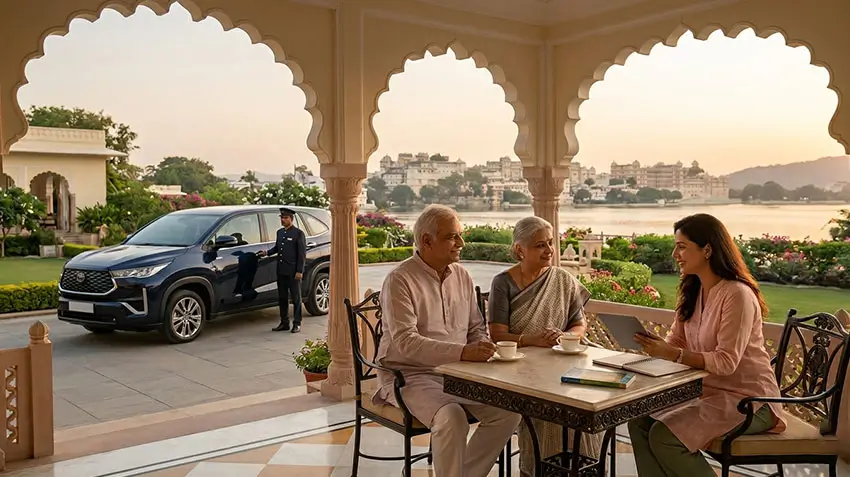
When you're sitting on the terrace of a palace hotel in Udaipur watching the sun drop behind the Aravalli Hills with your parents beside you, the planning - every detail of it - becomes irrelevant. What remains is the experience.
Your parents will remember this trip. So will you. That's worth the effort of getting it right.
Yes - with the right planning, India is an extraordinary destination for older travelers. The key factors are a dedicated private car and driver, a slow-travel itinerary that doesn't overpack each day, carefully selected accessible hotels, and a tour operator experienced in managing trips for senior travelers. North India and Rajasthan in particular offer world-class heritage experiences at a pace that suits older adults when planned correctly.
The Golden Triangle - Delhi, Agra, and Jaipur - combined with Udaipur and Jodhpur in Rajasthan forms the most rewarding and manageable circuit for elderly travelers. These destinations offer iconic experiences, excellent luxury hotels, and relatively good accessibility compared to other parts of India. South India's Kerala is also very well suited - flat backwater cruises, Ayurveda wellness options, and a calm pace make it ideal for older visitors.
The main approach to the Taj Mahal is a paved pathway that most elderly visitors manage comfortably. Golf carts and wheelchairs are available at the entrance for those who need them - confirm availability with your tour operator in advance. The main mausoleum platform involves steps, which some elderly visitors choose to view from ground level rather than climb. A private guide will manage the visit at exactly the pace your parents need.
Accessibility varies significantly between properties. Modern luxury hotels have elevators and accessible rooms as standard. Heritage palace hotels vary - some have been beautifully retrofitted with elevators and accessible bathrooms, while others retain original narrow staircases. Always confirm specific room accessibility requirements with your tour operator before the hotel is booked into your itinerary.
October through February is strongly recommended for elderly travelers. Temperatures across North India and Rajasthan are comfortable - warm during the day, cool in the evenings. March begins to warm up, and April through September brings heat and monsoon conditions that are genuinely taxing for older adults. December and January are peak season - book seven to nine months ahead.
Carry all prescription medications in their original labeled containers with a doctor's letter confirming the prescriptions. Bring enough supply for the full trip plus a buffer of five to seven additional days in case of any travel delays. Most common medications - heart medication, blood pressure drugs, diabetes management - are legal to bring into India. If any medication is a controlled substance, check India's specific regulations in advance and carry documentation.
Yes - with the right adjustments. Many of Rajasthan's most spectacular experiences are accessible even for travelers with limited mobility. Lake Pichola boat cruises in Udaipur, Mehrangarh Fort's elevator-accessed galleries in Jodhpur, ground-level palace courtyard visits in Jaipur - all of these are manageable. A private driver and guide who is briefed on your parents' mobility level will navigate each site thoughtfully, suggesting alternatives where the original plan isn't feasible.
A minimum of twelve to fourteen days is recommended for a luxury India tour with elderly parents that doesn't feel rushed. This allows two to three nights at each destination, genuine rest days, and the flexibility to adjust the pace if your parents need more downtime than originally planned. Trying to compress a North India and Rajasthan circuit into eight or nine days results in a trip that's genuinely exhausting for older travelers.
Be specific and honest. Tell your operator about mobility limitations, dietary restrictions, medical conditions that may affect pacing, any equipment like walking aids or wheelchairs, bathroom frequency needs, and any activities that should be avoided. A good luxury private India tour operator will use this information to select the right hotels, plan appropriate daily schedules, and brief your driver and guides accordingly.
Eating at reputable hotels and operator-recommended restaurants - which your private tour arrangements will naturally direct you toward - is safe for elderly travelers. Avoid street food, raw salads, and untreated water. Stick to bottled water exclusively. Indian cuisine at quality restaurants is varied enough to accommodate most dietary preferences, and luxury heritage hotels in Rajasthan typically offer both Indian and continental menu options.
A reputable luxury private India tour operator provides 24/7 on-ground support specifically for situations like this. Your operator will know the nearest quality medical facilities at every point in your itinerary, and your private driver will handle transport immediately. This is also why comprehensive travel insurance - including medical evacuation coverage - is essential when traveling to India with elderly parents.
Yes - and this is one of the most important advantages of a private luxury India tour over a group package. If your parents need an extra rest day in Udaipur, your itinerary adjusts. If the morning at Amber Fort was tiring and you want to skip the afternoon activity, it's a conversation with your driver - not a fight with a group tour coordinator. The flexibility of a private arrangement is not a luxury. For families traveling with elderly parents, it's a necessity.